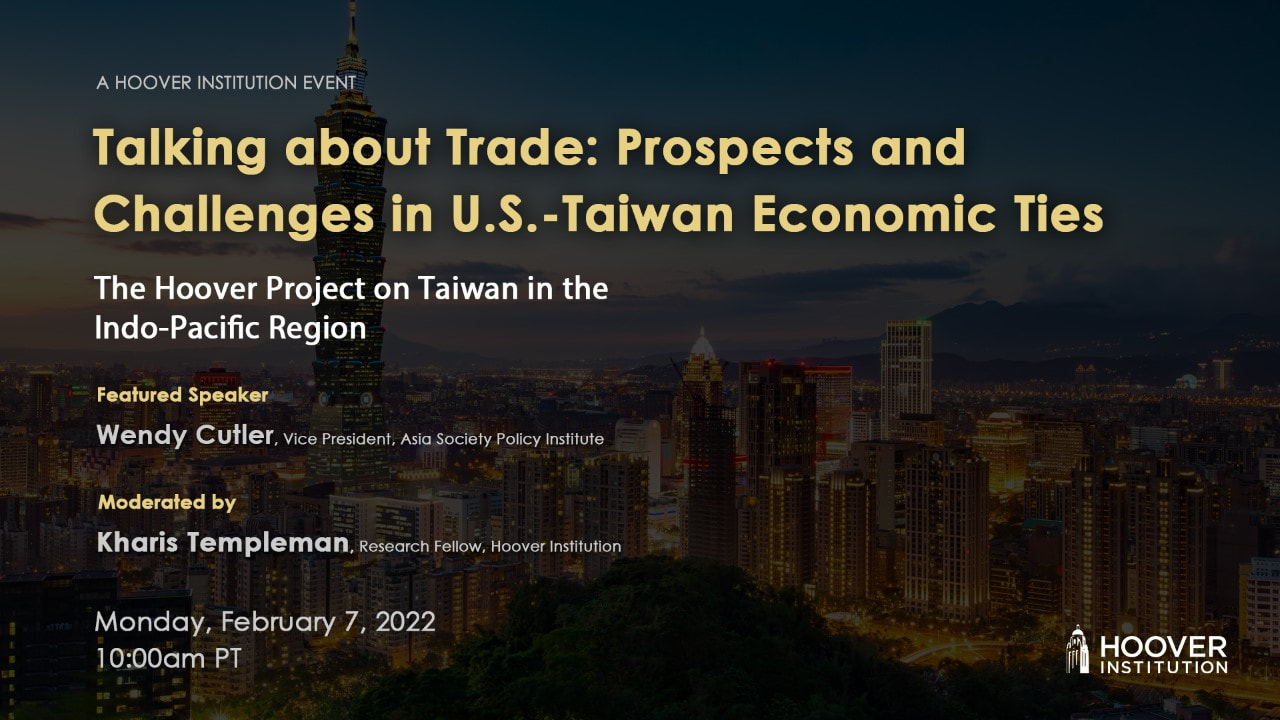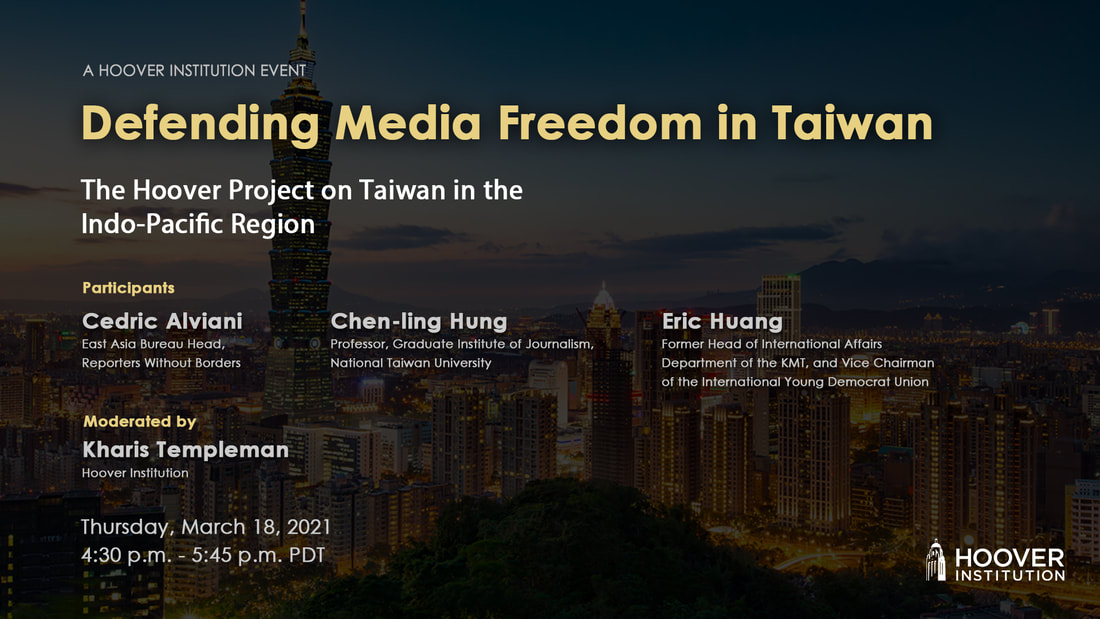
Kharis Templeman (祁凱立)
中文姓名:祁凱立
  • Home
  • Research
  • Teaching
  • CV
  • Blog
  • Taiwan Studies Resources

PTIP Annual Conference - Taiwan After The 2024 Elections

5/23/2024

0 Comments

 
Picture
On behalf of the Project on Taiwan in the Indo-Pacific Region and The Global Policy and Strategy Initiative, the Hoover Institution invites you to Taiwan After the 2024 Elections Annual Conference, Thursday, May 23, 2024, from 8:30 AM - 5:15 PM to Friday, May 24, 2024 from 8:45 AM - 2:00 PM in HHMB 160.
​
Taiwan’s next president William Lai (賴清德) takes office on May 20, 2024. His victory in the January 2024 elections ensures that the ruling Democracy Progressive Party (DPP) will hold the presidency for an unprecedented third consecutive term. But Lai won only 40 percent of the presidential vote, and the opposition Kuomintang (KMT) and Taiwan People’s Party (TPP) together now control a majority of the seats in the legislature. President-elect Lai’s new administration is also likely to face continued pressure from the People’s Republic of China (PRC), and he will have to deal with an increasingly complex and uncertain international environment.  
 
Join us as we bring together a diverse group of experts to discuss the policy challenges and opportunities that the incoming Lai administration will face. It will feature panels on the 2024 election results, governance challenges, the future of Taiwan’s economy, security and defense issues, US-Taiwan-PRC relations, and perspectives of key U.S. allies and partners on the U.S.-Taiwan relationship.
​
This conference will bring together a diverse group of experts to discuss the policy challenges and opportunities that the incoming Lai administration will face. It will feature panels on the 2024 election results, governance challenges, the future of Taiwan’s economy, security and defense issues, US-Taiwan-PRC relations, and perspectives of key U.S. allies and partners on the U.S.-Taiwan relationship.

Agenda

Participant Bios

​Conference Report
0 Comments

PTIP: Taiwan Roundtable Discussion On Cold War/Martial Law Formations of Taiwanese America

5/13/2024

0 Comments

 
Picture
On behalf of Taiwan in the Indo-Pacific Region and its National Security Task Force the Hoover Institution held a Taiwan Roundtable Discussion On Cold War / Martial Law Formations of Taiwanese America on Monday, May 13, 2024 from 2-3:30 p.m. PT in Stauffer Auditorium. 

This event features Wendy Cheng, Professor of American Studies and core faculty in the Intercollegiate Department of Asian American Studies at Scripps College. She is the author of Island X: Taiwanese Student Migrants, Campus Spies, and Cold War Activism (University of Washington Press, 2023) and The Changs Next Door to the Díazes: Remapping Race in Suburban California (University of Minnesota Press, 2013), and coauthor of A People’s Guide to Los Angeles (University of California Press, 2012).


Picture
From the 1960s to 1980s, more than a hundred thousand Taiwanese students migrated to the US for graduate study in science, technology, engineering, and medicine fields as part of the special Cold War relationship between the US and the authoritarian Kuomintang (KMT) government in Taiwan. This same time period overlapped with a 38-year period of martial law in Taiwan, during which the KMT surveilled and terrorized Taiwanese nationals not only in Taiwan but also in the U.S., Japan, and other locations around the world. In the U.S., this occurred with the full knowledge and tacit permission of the US state.

With information drawn from extensive interviews and archival research, we'll discuss how Taiwanese students were politicized and organized themselves on U.S. university campuses under these dual conditions of selective Cold War migration and martial law, and how their politics were more heterogeneous and far-reaching than how they are typically remembered today.

My opening remarks are below: 

​
Before I turn the microphone over to Prof. Cheng. I’d also like to offer a couple observations about this topic.

I have been wishing for a long time that someone would write this book. The field of Taiwan studies has grown by leaps and bounds over the past few years, but the issue of spying and harassment of Taiwanese students in the United States has been almost invisible in English-language scholarship and quite sensitive among Taiwanese communities.

These episodes deserve a lot more attention.

First, the Taiwanese overseas student experience has deep historical significance for American academia. As Prof. Cheng documents in the book, there are dozens of campuses with documented cases of spying. Stanford is among them. Let me reiterate that. This university had agents of a foreign power reporting on the political attitudes and activities of students, with real consequences not just for themselves but their families and friends back home. It’s important that people here be aware of this history and the chilling effect it had on academic freedom for these communities.
​
Now, Taiwan has come a long way since that time, a development that is worth celebrating. But it is still wrestling with the legacies of the authoritarian era. And in the search for transitional justice, one of the most important and powerful acts is truth telling. In this book, Wendy tells difficult truths – about the long reach of the martial-law-era regime in Taiwan, about U.S. government complicity or indifference, and about the struggles over Taiwan’s status on American campuses – struggles that have mostly been forgotten after Taiwan democratized and a new wave of students from the PRC changed the locus of contention.
 
Second, the debate over academic freedom and foreign coercion has obvious contemporary relevance. American universities are once again confronting questions about transnational repression, or “sharp power,” “foreign influence operations,” or whatever other terms we might use to describe this phenomenon, especially but not only from the authoritarian People’s Republic of China (PRC). In the current debates over academic freedom that are roiling many university campuses around the country, we are in danger of missing a crucial distinction: the curtailing of speech, academic inquiry, and political organizing on university campuses via the covert, coercive acts of a foreign government are a gross violation of that fundamental freedom. As Prof. Cheng documents, American universities did not respond well in previous decades to this coercive activity when it was directed against students from Taiwan. It should be our hope that they do a better job in the current environment, now that students from other countries face similar threats. 
 
With that, I will turn the mic over to Wendy Cheng. Thank you.
0 Comments

PTIP: Taiwan Roundtable Discussion with Ingrid Larson, Managing Director, American Institute in Taiwan

3/7/2024

0 Comments

 
Picture
Ingrid Larson, Managing Director of AIT Washington, and Representative to the United States Hsiao Bi-khim bump elbows.
On behalf of Taiwan in the Indo-Pacific Region and its National Security Task Force the Hoover Institution invites you to a Taiwan Roundtable Discussion on Thursday, March 7, 2024 from 2-3:30 p.m. PT at Stauffer Auditorium. 

Picture
​The Project on Taiwan in the Indo-Pacific Region invites you to join a private roundtable discussion with Ingrid Larson, the Managing Director of the American Institute in Taiwan - Washington office, and a 20+ year member of the U.S. Foreign Service. She previously served as Director for Taiwan Coordination at the State Department. Director Larson will speak about the current administration’s policy towards Taiwan as well as the purpose and evolution of AIT’s unique role and structure in the current era of
US-China relations. 

0 Comments

PTIP: Taiwan’s 2024 Presidential And Legislative Elections: What Happened And What It Means

1/25/2024

0 Comments

 
Picture
On behalf of Taiwan in the Indo-Pacific Region and its National Security Task Force the Hoover Institution invites you to Taiwan’s 2024 Presidential and Legislative Elections: What Happened and What It Means on Thursday, January 25, 2024 from 4:00 - 5:30 PM PT. 

On January 13, the Taiwan voters delivered a split verdict: the DPP’s Lai Ching-te won the presidential election and secured an unprecedented third consecutive term for the ruling party. But 60 percent of voters cast ballots for someone else, and the DPP lost its majority in the legislature. The biggest shift in voting patterns was the rise of third-party candidate Ko Wen-je, the former mayor of Taipei, who received 26 percent of the vote and did especially well among young voters. Ko’s Taiwan People’s Party will also hold the balance of power in a closely divided legislature.

In this event, three panelists discuss what happened, why it happened, and what it means for Taiwan’s domestic politics, cross-Strait relations, and the balance of power in the Indo-Pacific region. 
​
ABOUT THE PARTICIPANTS
Larry Diamond is the William L. Clayton Senior Fellow at the Hoover Institution, the Mosbacher Senior Fellow in Global Democracy at the Freeman Spogli Institute for International Studies (FSI), and a Bass University Fellow in Undergraduate Education at Stanford University. He is also professor, by courtesy, of political science and sociology at Stanford. He co-chairs the Hoover Institution’s programs on China’s Global Sharp Power and on Taiwan in the Indo-Pacific Region.  
​
Kharis Templeman is a research fellow at the Hoover Institution and part of the Project on Taiwan in the Indo-Pacific. Templeman is a political scientist (Ph.D. 2012, Michigan) with research interests in Taiwan politics, democratization, elections and election management, party system development, and politics and security issues in Pacific Asia.

Stephen Tan is Managing Director of International Policy Advisory Group, a Taipei-based consulting firm, providing corporate clients with solutions to issues relating to geopolitical risks, strategic planning on supply chain, regulatory policy and government relations matters. Stephen was President of Cross-Strait Policy Association in 2016-2022, Visiting Fellow of Brookings Institute in 2018-2019, and Partner of Baker McKenzie from 2004 to 2016. He previously served as a board member of American Chamber of Commerce Taiwan for more than a decade, and is currently sitting on the board of directors of a handful of non-profit organizations as well as listed companies based in Taiwan.  Stephen frequently appears on Taiwan’s television, radio and other programs as a political commentator, and shares his perspectives on issues including Taiwan-US relations, cross-strait relations and Taiwan’s domestic policy issues. He is a graduate of National Taiwan University, University of Pittsburgh School of Law, and Carnegie Mellon University School of Business.

Tiffany (Chun-An) Wang is a fourth-year PhD candidate in Applied Physics at Stanford University. Her research interests focus on novel material synthesis for electronics and energy applications. She currently serves on the board of directors at the North America Taiwanese Engineering and Science Association (NATEA) (2022–present) and was the president of the Stanford Taiwanese Student Association (STSA) (2021–2022). She founded Stanford Salon PSI and has organized g0v Silicon Valley civil-tech hackathons since 2023.
0 Comments

PTIP: Taiwan's 2024 General Elections -- The Campaign So Far

12/1/2023

0 Comments

 
Picture
On behalf of Taiwan in the Indo-Pacific Region, the Hoover Institution held Taiwan's 2024 General Elections: The Campaign So Far on Wednesday, November 29, 2023. The recording of this event is now available at the PTIP program website. 

On January 13, 2024, Taiwan voters will go to the polls to elect a new president and legislature. The results could have major implications for Taiwan’s relationship with the United States and the People’s Republic of China (PRC), as well as the peace and stability of the Indo-Pacific.

​In this event, three experts on Taiwan’s domestic politics weigh in on the state of the race, including the leading presidential candidates and parties, the messages of each campaign, and the issues animating the race so far. As the campaign enters the home stretch, they discuss the role of the PRC and the United States in the election, the most likely outcomes, and the consequences for the trilateral U.S.-Taiwan-PRC relationship. 

Featuring

Chiaoning Su is an Associate Professor in the Department of Communication, Journalism, and Public Relations at Oakland University, where she also serves as the Director of the Barry M. Klein Center for Culture and Globalization. Su is a communication scholar (Ph.D., 2015, Temple University) with a dual focus on two interrelated strands: the journalism of crisis and journalism in crisis. Her first line of inquiry delves into the representation and production of crisis news, while her second line of research centers on the role of journalism in the context of diminishing democracy. Her work has been published in Media, Culture, and Society, International Journal of Communication, Asian Journal of Communication, Taiwan Journal of Democracy, and Communication Review. Prior to her academic career, Su gained valuable professional experience as a communication specialist at Ogilvy Public Relations and worked on several political campaigns in Taiwan.

Dennis Lu-Chung Weng is an Associate Professor of Political Science at Sam Houston State University and the founding Director of the Asia Pacific Peace Research Institute (APPRI). He obtained his Ph.D. from the University of Texas at Dallas in 2014. Dr. Weng has formerly taught at institutions including Wesleyan University and SUNY-Cortland. He currently holds research fellowships at Stellenbosch University and National Chengchi University, Taiwan. His research centers on comparative politics, international relations, and the dynamics between domestic political behavior and international politics, particularly in the US and Asia-Pacific regions. A recognized expert in his field, Dr. Weng's insights have been featured in scholarly publications, op-eds, and various media outlets. He is a noted commentator on US China-Taiwan relations and political events in both the US and Asia.

MODERATOR
Kharis Templeman is a research fellow at the Hoover Institution and part of the Project on Taiwan in the Indo-Pacific. Templeman is a political scientist (Ph.D. 2012, Michigan) with research interests in Taiwan politics, democratization, elections and election management, party system development, and politics and security issues in Pacific Asia.
​
INTRODUCTION BY
Larry Diamond is the William L. Clayton Senior Fellow at the Hoover Institution, the Mosbacher Senior Fellow in Global Democracy at the Freeman Spogli Institute for International Studies (FSI), and a Bass University Fellow in Undergraduate Education at Stanford University. He is also professor, by courtesy, of political science and sociology at Stanford. He co-chairs the Hoover Institution’s programs on China’s Global Sharp Power and on Taiwan in the Indo-Pacific Region.  
0 Comments

PTIP: The World's Most Dangerous Place? Assessing the Prospects for War and Peace in the Taiwan Strait

11/16/2023

0 Comments

 
On behalf of Taiwan in the Indo-Pacific Region and its National Security Task Force, the Hoover Institution held The World’s Most Dangerous Place? Assessing the Prospects for War and Peace in the Taiwan Strait on Tuesday, November 14, 2023 at 12:00 PM PT. 
​
In recent years, numerous analysts have warned of an increasing risk of war in the Taiwan Strait. Others, however, have argued that military conflict remains unlikely, and that the risk of war should not be over-hyped. Drawing from his recent book, Scott Kastner outlines a framework through which to assess the prospects for military conflict between China and Taiwan. Drawing on international relations theory, Kastner outlines several causal pathways through which a Taiwan Strait conflict could occur, and assesses how broad trends in China-Taiwan-US relations are affecting the likelihood of these different scenarios. He concludes with policy suggestions for how actors in Beijing, Taipei and Washington could mitigate the risks of a war in the Taiwan Strait.

About the Participants

Picture
Scott L. Kastner is a professor in the Department of Government and Politics at the University of Maryland, College Park. He graduated from Cornell University and received his Ph.D. in Political Science from the University of California, San Diego. His books include Political Conflict and Economic Interdependence across the Taiwan Strait and Beyond (Stanford University Press, 2009); China’s Strategic Multilateralism: Investing in Global Governance (Cambridge University Press, 2019; with Margaret Pearson and Chad Rector); and War and Peace in the Taiwan Strait (Columbia University Press, 2022).
​
Kharis Templeman is a research fellow at the Hoover Institution and part of the Project on Taiwan in the Indo-Pacific. Templeman is a political scientist (Ph.D. 2012, Michigan) with research interests in Taiwan politics, democratization, elections and election management, party system development, and politics and security issues in Pacific Asia.

0 Comments

Stanford Democracy Day Event: Film Screening of Invisible Nation

11/3/2023

0 Comments

 
Picture
On November 2, the Project on Taiwan in the Indo-Pacific Region, the Center for East Asian Studies, and the Stanford Taiwan Science and Technology Hub co-sponsored a film screening of the documentary Invisible Nation, a poignant examination of Taiwan's contested status during the era of Tsai Ing-wen, the current President of the Republic of China (Taiwan). 

This Stanford Democracy Day 2023 event featured a Q&A with director Vanessa Hope and a pre-recorded introduction from Taiwan’s Digital Minister Audrey Tang.

Synopsis
With unprecedented access to Taiwan’s sitting head of state, director Vanessa Hope investigates the election and tenure of Tsai Ing-wen, the first female president of Taiwan. Thorough, incisive and bristling with tension, Invisible Nation is a living account of Tsai’s tightrope walk as she balances the hopes and dreams of her nation between the colossal geopolitical forces of the U.S. and China. Hope’s restrained observational style captures Tsai at work in her country’s vibrant democracy at home, while seeking full international recognition of Taiwan’s right to exist. At a time when Russia’s invasion of Ukraine has demonstrated the ever-present threat of authoritarian aggression, Invisible Nation brings punctual focus to the struggle of Taiwan as it fights for autonomy and freedom from fear.​​

Director Biography
Vanessa Hope is an award-winning producer and director. Vanessa has produced multiple acclaimed films in China including Berlin International Film Festival selection, Wang Quanan's The Story Of Ermei and Cannes Film Festival selection, Chantal Akerman's Tombee De Nuit Sur Shanghai, part of an omnibus of films, The State Of The World. She has also produced her own short films, including China In Three Words, an official selection at DOC NYC. Hope’s additional producing credits include Zeina Durra’s The Imperialists Are Still Alive! and Sarah and Emily Kunstler's feature documentary, William Kunstler: Disturbing The Universe and the award-winning film, Who We Are: A Chronicle of Racism in America. She served as Executive Producer of Paula James-Martinez’s Born Free.
Hope made her directorial debut with the documentary All Eyes and Ears, an exploration of the complex links between the U.S. and China told through the stories of U.S. Ambassador Jon Huntsman, his adopted daughter Gracie Mei, and civil advocate Chen Guangcheng. Hope’s latest film, Invisible Nation, is about the first female president of Taiwan, Tsai Ing-wen, and the story of Taiwan’s geopolitical predicament, with dangerous parallels to Ukraine. Vanessa and her husband, Ted Hope, share a company, Double Hope Films, with many independent fiction and documentary features and series in development. Vanessa is on the advisory board of the Equal Rights Amendment Coalition and the Fund for Women’s Equality.
0 Comments

PTIP: Deepening U.S.-Taiwan Cooperation Through Semiconductors

10/20/2023

0 Comments

 
Picture
On October 19, the Hoover Institution's Project on Taiwan in the Indo-Pacific Region held a joint event with National Tsing Hua University in Hsinchu, Taiwan, to discuss how to deepen U.S.-Taiwan cooperation in semiconductors.  

Taiwan is one of Asia’s most prosperous and successful liberal democracies, the world’s leading innovator in and producer of semiconductors, and a trusted partner in critical supply chains. While Taiwan stands at the center of the global semiconductor economy, its lack of diplomatic recognition and formal alliances contributes to its existential vulnerability to being invaded or otherwise involuntarily absorbed into the People’s Republic of China (PRC).

This event brought together participants from the Hoover Institution to discuss these issues with Taiwan counterparts, and to consider the recommendations of a new Hoover Institution report entitled “Silicon Shield: US- Silicon Triangle: The United States, Taiwan, China, and Global Semiconductor Security.” The report is available for free download at the project website. 

For more on this topic, see the Hoover Institution's Working Group on Semiconductors and the Security of the United States and Taiwan. Some of the report chapter authors have also participated in podcasts about the report, which you can listen to here: 

Matt Turpin, on mitigating China's non-market behavior in semiconductors
Chris Ford, on how the United States can reduce vulnerabilities in semiconductor supply chains 
Mary Kay Magistad, on the future of U.S.-China competition
Glenn Tiffert, on why China struggles to produce advanced semiconductors

In addition, in July 2023, the report's editors appeared in Washington DC for a launch event. 


Participants
Terry Tsao is a seasoned executive and industry leader, currently serving as the Global Chief Marketing Officer and President of Taiwan at SEMI. In his current capacity, Terry Tsao assumes the responsibility of directing corporate marketing strategies of SEMI, encompassing various critical areas such as strategy formulation, association operations, product marketing, and market communications. Moreover, he leads the SEMI Market Intelligence Team, driving data-driven insights and actionable intelligence within the organization. In his leadership position for SEMI Taiwan, Tsao oversees all aspects of activity planning, product offerings, and service content. With over 16 years of experience at SEMI, Tsao has significantly advanced Taiwan's semiconductor community and spearheaded crucial policy initiatives within the global semiconductor industry. Prior to his current position, Tsao held dual roles as the President of SEMI Taiwan and the President of SEMI Southeast Asia, leveraging his extensive experience to drive advancements in the semiconductor industry across multiple regions.

Tain-Jy Chen is a senior professor of economics at TSE, and also a professor emeritus of National Taiwan University. In addition to teaching, he has previously served as the president of Chung-Hua Institution for Economic Research, a think tank specializing in economic policy studies, and also in the Taiwan government, as the minister for Council for Economic Planning and Development (CEPD) and National Development Council (NDC). This experience gives him wide exposures to policy formations and implementations. As an economist, his research interests are in economic development and trade policies. He earned a Ph.D. degree in economics in 1983 from Pennsylvania State University. He has published extensively in academic journals, mostly in the fields of trade, investment, and industrial development. His recent work focuses on industrial development of China and the US-China trade war.

Kuo-Chun Yeh
is a professor at the Graduate Institute of National Development, a researcher at Center for China Studies, and Coordinator of China Research Program, National Taiwan University.  He is Secretary-general of the Chinese Association of Political Science (CAPS Taipei).  Since 2021 he has been an EU Jean Monnet Chair focusing on the EU-China industrial competition.

Burn-Jeng Lin is a Distinguished Senior Professor at National Tsing Hua University, a position he has held since retiring as Vice President of TSMC in 2016. He joined TSMC as a senior director in 2000 and became Vice President in 2011. Prior to that, he founded and led Linnovation, Inc. From 1970 to 1992, Dr. Lin worked at IBM, where he held various technical and managerial positions and was the first person to propose immersion lithography, a technique that eventually became viable in the 1980s. Dr. Lin is an IEEE Life Fellow and SPIE Fellow and was elected to the membership of the United States National Academy of Engineering in 2008 and as an Academician of Academia Sinica in 2014. He received a B.S. from National Taiwan University and his M.S. and Ph.D. in Electrical Engineering from Ohio State University.

FEATURING:
Larry Diamond - Senior Fellow at the Hoover Institution
James O. Ellis - Annenberg Distinguished Fellow at the Hoover Institution
Kharis Templeman - Research Fellow at the Hoover Institution
H.-S. Philip Wong - Willard R. and Inez Kerr Bell Professor in the School of Engineering at Stanford University

0 Comments

Stanford Student Job Opportunity: Hoover Student Fellowship Program

8/13/2023

0 Comments

 
Picture
Come work with me! The Hoover Project on Taiwan in the Indo-Pacific Region has an opening for a student research fellow for the 2023-24 academic year (Fall, Winter, Spring quarters) at Stanford.

​The Hoover Student Fellowship Program (HSFP) offers Stanford students a competitive opportunity to participate in important work at the Hoover Institution across both key research initiatives and organizational areas. The program is a 3-quarter-long paid fellowship in which students will be paired in topical areas of their preference with Hoover fellows or staff members.

Students in the fellowship will provide research and operational support, while also benefiting from mentorship and partaking in exclusive programming for the fellowship cohort. Students should expect not only guidance from their mentors and research supervisors, but also a chance to learn more about research, policy, and public affairs from influential leaders at Hoover and beyond. The fellowship will take place in-person throughout the academic year.

Applications due: Thursday, August 31, 2023 @ 11:59 PM.

Apply here. (You will need a valid Stanford email address to apply). Note that this is one of many possible research opportunities listed on the program website. The Taiwan project description is below: 

​Governing Taiwan: Making Democracy Work
The student fellow will provide research assistance on a book-length project to examine the evolution of Taiwan’s political institutions after its transition to democracy. The project seeks applicants with an interest in Taiwanese politics, East Asian Studies, political institutions, or the Taiwanese legal system. The successful candidate will have near-native reading proficiency in Chinese and some prior familiarity with Taiwan’s political history and institutions. A background in legal or political studies is a plus.
0 Comments

Book Talk: Divided Allies, with Hsiao-Ting Lin

5/30/2023

0 Comments

 
Picture
On behalf of Taiwan in the Indo-Pacific Region and its National Security Task Force the Hoover Institution invites you to a book talk on Divided Allies: Taiwan, the United States, and the Hidden History of the Cold War in Asia, with Hsiao-ting Lin on Thursday, June 1, 2023 from 4:00 - 5:00 PM PT.

Register here to attend this virtual talk. 
​
Professor Lin’s book explores the challenges which faced the United States and Taiwanese alliance during the Cold War, addressing a wide range of events and influences of the period between the 1950s and 1970s. Tackling seven main topics to outline the fluctuations of the U.S.–Taiwan relationship, this volume highlights the impact of the mainland counteroffensive, the offshore islands, Tibet, Taiwan’s secret operations in Asia, Taiwan’s Soviet and nuclear gambits, Chinese representation in the United Nations, and the Vietnam War. Utilizing multinational archival research, particularly the newly available materials from Taiwan and the United States, it reevaluates Taiwan’s foreign policy during the Cold War, revealing a pragmatic and opportunistic foreign policy disguised in nationalistic rhetoric.


Picture
About the Speaker
Hsiao-ting Lin is a research fellow and curator of the Modern China and Taiwan collection at the Hoover Institution, for which he collects material on China and Taiwan, as well as China-related materials in other East Asian countries. He holds a BA in political science from National Taiwan University (1994) and an MA in international law and diplomacy from National Chengchi University in Taiwan (1997). He received his DPhil in oriental studies in 2003 from the University of Oxford. He has published extensively on modern Chinese and Taiwanese politics, history, and ethnic minorities, including Accidental State: Chiang Kai-shek, the United States, and the Making of Taiwan (2016); Modern China’s Ethnic Frontiers: A Journey to the West (2011); and Tibet and Nationalist China’s Frontier: Intrigues and Ethnopolitics, 1928–49 (2006).

0 Comments
<<Previous
Forward>>

    RSS Feed

    About Me

    I am a political scientist with research interests in democratization, elections and election management, parties and party system development, one-party dominance, and the links between domestic politics and external security issues. My regional expertise is in East Asia, with special focus on Taiwan.

    Posting on Bluesky @kharist.bsky.social

    Archives

    November 2025
    October 2025
    September 2025
    August 2025
    July 2025
    June 2025
    April 2025
    February 2025
    January 2025
    November 2024
    October 2024
    May 2024
    March 2024
    January 2024
    December 2023
    November 2023
    October 2023
    August 2023
    May 2023
    April 2023
    March 2023
    February 2023
    January 2023
    December 2022
    November 2022
    October 2022
    September 2022
    August 2022
    June 2022
    May 2022
    April 2022
    March 2022
    February 2022
    January 2022
    December 2021
    March 2021
    February 2021
    December 2020
    October 2020
    September 2020
    August 2020
    July 2020
    June 2020
    September 2019
    August 2019
    November 2018
    August 2018
    June 2018
    February 2018
    January 2018
    October 2017
    August 2017
    December 2016
    November 2016
    September 2016
    August 2016
    July 2016
    March 2016
    February 2016
    January 2016
    December 2015
    November 2015
    October 2015
    September 2015
    July 2015
    June 2015
    May 2015
    March 2015
    February 2015
    January 2015
    November 2014
    October 2014
    September 2014
    August 2014
    July 2014
    May 2014
    April 2014
    March 2014
    February 2014
    January 2014
    December 2013
    November 2013
    October 2013
    September 2013

    Categories

    All
    1992 Elections
    2008 Elections
    2012 Elections
    2014 Elections
    2016 Elections
    2020 Elections
    2022 Elections
    2024 Elections
    2026 Elections
    Aacs
    Aborigines
    Alex Tsai
    Alicia Wang
    Annette Lu
    Announcements
    Apsa
    Apsa Cgots
    Arthur P Wolf
    Artificial Intelligence
    Blog Meta
    Book Review
    Brookings Institution
    Campaign Regulation
    CCP
    CDDRL
    CEC
    Chang Ching Chung
    Chang Chun Hsiung
    Chang Jung-wei
    Chang Li-shan
    Chang Ming-ta
    Chang Sho-wen
    Chen Che-nan
    Chen Chien-nian
    Chen Chi Mai
    Chen Chin-te
    Chen Ding-nan
    Chen Fu-hai
    Cheng Chao-fang
    Cheng Cheng-ling
    Cheng Pao-ching
    Chen Kuang-fu
    Chen Kuan-ting
    Chen Ming-wen
    Chen Ou-pu
    Chen Shih Chung
    Chen Shih-chung
    Chen Shui Bian
    Chen Tsang-chiang
    Chen Wan-hui
    Chen Wei-chung
    Chen Ying
    Chen Yu-chen
    Chiang Chi Chen
    Chiang Chi-chen
    Chiang Ching Kuo
    Chiang Jui-hsiung
    Chiang-kai-shek
    Chiang Tsung-yuan
    Chiang Wan An
    Chiang Wan-an
    Chin Hui Chu
    Chou Chiang-chieh
    Chou Chun-mi
    Chou Hui-huang
    Chuang Suo Hang
    Chung Chia-pin
    Chung Tung-chin
    Citizen 1985
    Civil Society
    Conferences
    Control Yuan
    Council Of Grand Justices
    Cross-party-negotiating-committee
    Cross Strait Relations
    CSSTA
    Defense Spending
    Demography
    Developmental State
    Diplomacy
    Disinformation
    DPP
    DPP Policy Papers
    Eats
    Economic Security
    Economic Voting
    Electoral Geography
    Electoral Reform
    Electoral Systems Wonkery
    Energy Policy
    Eric Chu
    Executive Yuan
    Fan Yun
    Fellowship
    Frank Hsieh
    Freddy Lim
    Frida Tsai
    Fu Kun Chi
    Fu Kun-chi
    Germany
    Han Kuo Yu
    Han Kuo-yu
    Hau Lung Bin
    Hau Pei Tsun
    Henry Rowen
    Ho Kan-ming
    Hoover Institution
    Housing
    Hou You Yi
    Hou You-yi
    Hsiao Bi Khim
    Hsiao Bi-khim
    Hsieh Fu-hung
    Hsieh Kuo Liang
    Hsieh Kuo-liang
    Hsieh Lung-chieh
    Hsieh Sam Chung
    Hsu Chen-wei
    Hsu Chih-jung
    Hsu Chung-hsin
    Hsu Hsin-ying
    Hsu Shu-hua
    Hsu Ting-chen
    Huang Hong-cheng
    Huang Kuo Chang
    Huang Kuo-chang
    Huang Min-hui
    Huang Shan Shan
    Huang Shan-shan
    Huang Shih Ming
    Huang Shiou-fang
    Huang Wei-che
    Huang Yung-chin
    Human Rights
    Hung Hsiu Chu
    Hung Tzu Yung
    Hung Tzu-yung
    Influence Operations
    In Memoriam
    Internship
    James Soong
    Japan
    Jiang Yi Huah
    Job Market
    John Chiang
    John Wu
    Journal Of Democracy
    Judicial Yuan
    Kao Hung An
    Kao Hung-an
    Kawlo Iyun Pacidal
    Ker Chien Ming
    KMT
    Kmt History
    Ko Chih-en
    Kolas Yotaka
    Ko Wen Je
    Lai Ching Te
    Lai Ching-te
    Lai Feng-wei
    Lai Hsiang-ling
    Lee Chin-yung
    Lee Chun Yi
    Lee Chun-yi
    Lee Teng-hui
    Legal-wonkery
    Legislative Yuan
    Liang-kuo-shu
    Liang Su Jung
    Lien Chan
    Lii Wen
    Lin Chia-lung
    Lin Chih-chien
    Lin Fei-fan
    Lin Geng-ren
    Lin Hung Chih
    Lin Ming-chen
    Lin Tsung-hsien
    Lin Yang Kang
    Lin Zi Miao
    Lin Zi-miao
    Liu Chao-hao
    Liu Cheng-ying
    Liu Chien-kuo
    Liu Kuo Tsai
    Lo Chih Cheng
    Lu Hsiu Yi
    Lu Shiow-yen
    Martial Law
    Ma Vs Wang
    Ma Ying Jeou
    Media
    Media Freedom
    Min Kuo Tang
    Nationalism
    Natsa
    NCC
    New Power Party
    Nuclear Power
    Occupy LY
    Pingpuzu
    Political Economy
    Political Science
    PRC
    PTIP
    Publications
    Public Opinion
    Quality Of Democracy
    Ramon Myers
    Rao Ching-ling
    Recall Elections
    ROC Constitution
    Russia
    Saidai Tarovecahe
    Sean Lien
    Security Studies
    Semiconductor Industry
    Shen Hui-hung
    Shen Lyu Shun
    Simon Chang
    Song Kuo-ting
    South Korea
    Speaker Series
    Stanford
    Statistics
    Street Protests
    Su Ching-chuan
    Su Huan-chih
    Su Jia Chyuan
    Su Jia-chyuan
    Sunflower Movement
    Su Tseng-chang
    Taiwanese Economy
    Taiwan Journal Of Democracy
    Taiwan People's Party
    Taiwan Rural Front
    Taiwan Solidary Union
    Taiwan Studies
    Taiwan World Congress
    Terry Gou
    Testimony
    The Diplomat
    This Week In Taiwan
    Ting Shou Chung
    Tpp
    Trade Relations
    Trans Pacific Partnership
    Tsai Chi-chang
    Tsai Ing Wen
    Tsai Shih-ying
    Tsao Chi-hung
    Tsao Er-yuan
    Tseng Yung Chuan
    Tzu Chi
    Ukraine
    United Nations
    Uscc
    US Taiwan NextGen
    Us Taiwan Relations
    V-dem
    Wang Chien-hsien
    Wang Chung-ming
    Wang Huei-mei
    Wang Jin Pyng
    Wang Mei-hui
    Wan Mei-ling
    Wei Yao Kan
    Wellington Koo
    Weng Chang-liang
    Wild Lily Movement
    Wilson Center
    Wu Den Yi
    Wu Yung Hsiung
    Xi Jinping
    Yang Cheng-wu
    Yang Shi-chiu
    Yang Wen-ke
    Yang Yao
    Yao Eng-chi
    Yao Wen-chih
    Yosi Takun
    You Si-kun
    Yu Shyi Kun

    RSS Feed

Powered by Create your own unique website with customizable templates.