Kharis Templeman (祁凱立)
中文姓名:祁凱立
  • Home
  • Research
  • Teaching
  • CV
  • Blog
  • Taiwan Studies Resources

The Curious Case of the Taiwan People's Party, Part 4: What LY Roll-Call Votes Miss

7/20/2025

0 Comments

 
This is Part 4; for previous posts see Part 1, Part 2, and Part 3. 
Picture
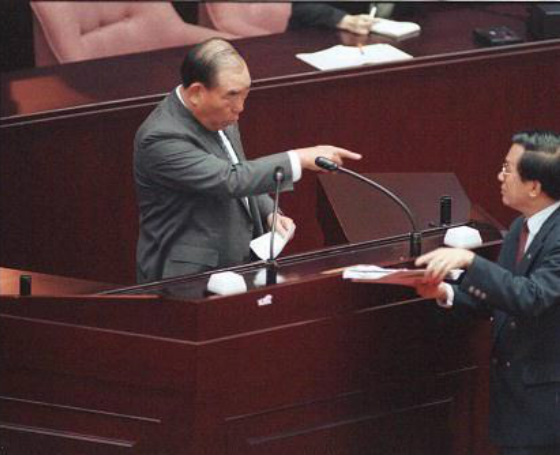
The Speaker's Podium, ready for the next battle.
To recap the argument so far: The Taiwan People's Party (TPP) controls the critical voting bloc in the Legislative Yuan, but it has not maximized the leverage that voting bloc gives it. 
  1. It has not sought to obtain offices (LY speaker or deputy speaker, or cabinet positions) for its members. 
  2. It has not sought concrete policy concessions from either the DPP or KMT in return for its support. 
  3. It has not tried to maximize its appeal to the general electorate, and it has behaved like a pan-blue party rather than a centrist one. 
​
This behavior is puzzling! 

What Is the TPP Doing? 
I have argued that the TPP is trying to bring about a partisan realignment within the pan-blue camp, away from the KMT. This is the only goal for which the TPP’s current strategy appears rational. It's an unusual strategy, but one that makes some sense given the political constraints the party faces.

Taiwan’s electoral institutions and party system present a high barrier to third-party growth. There is high party system institutionalization and politics and voting are now quite nationalized. The electoral system is permissive enough to allow small parties to gain a foothold in city councils and in the party list vote for the legislature, but they can never expand beyond small-party status unless they replace one of the Big Two. And no small party has ever succeeded in doing so in 30+ years of democratic elections.
 
So, to try to replace the KMT, the TPP needs to do two contradictory things at the same time.
  1. Convince pan-blue voters they are one of them, and in particular, to appeal to older KMT supporters while holding onto their younger base.
  2. Undermine the KMT, to change beliefs about the long-term viability of that party and convince their supporters that the TPP, not the KMT, is the future.

Now, if you were leading the TPP, how might you go about this? Toward the first goal, you'd pursue a public strategy of alignment with the KMT, especially on issues that you think make the DPP look bad. And toward the second, you'd quietly block legislation that would strengthen the KMT's grassroots or increase its popularity. 

Evidence for the first part of this strategy is obvious: Huang Kuo-chang is appearing in public regularly with the KMT, the TPP is publicly opposing the recall elections against KMT legislators, and (almost) everything controversial that has made it to a final vote in the LY has passed with joint KMT-TPP support over DPP objections. 

But what about the second? Can we find evidence of divergence of interests between the two party caucuses? This is harder to spot, because the TPP doesn't want KMT supporters to notice that it is trying to undermine the party's prospects. The TPP would rather be characterized as "marching in lockstep" with the KMT in its opposition to the DPP government, and everything else that matters to the KMT. 

But I don't think this is actually true.

Is the TPP Really Supporting Everything the KMT Wants in the LY?

Picture
Clearly, the engines and cockpit need to be reinforced.
To begin to see why this claim might be wrong, we need to talk about survivorship bias. Survivorship bias is the logical error of focusing on outcomes that survived a selection process, while overlooking those that did not. The classic example used to illustrate this form of bias comes from the Allied bombing campaign in World War II. The U.S. military did a systematic study of planes returning from bombing missions to try to understand how to improve aircraft survival while under fire. The study noted that certain areas like the wings and fuselage had more bullet holes than the rest, and recommended reinforcing these areas since they seemed to be getting hit a lot more. But this was a fallacy: a statistician, Abraham Wald, noted that the areas with the most bullet holes were places where the plane could be hit and still survive the mission. It was the other areas -- the ones that did not show much damage in surviving planes -- that were critical to surviving a bombing mission. Planes hit in the cockpit or engine simply didn't make it back, and so were not in the "sample" of planes examined.  

Now, what does the patterns of bomber survival in WWII have to do with the Taiwanese legislature? Well, there is also a selection process that occurs before bills introduced in the legislature come up for a vote. And we haven't paid adequate attention (and I include myself in this "we") to how that process might be skewing what we actually see being debated publicly, and being passed, by the TPP-KMT coalition over DPP objections. We need to consider the possibility that stuff the two pan-blue parties don't agree on never makes it to a vote. And it's possible this is happening a lot. 

​​The inference problem here is that we don't know what bills the TPP quietly blocked, because the vast majority of bills introduced in the LY don't come up for a vote. Moreover, as I noted above, the TPP doesn't generally want people to know when they disagree with the KMT on a bill. (And an important corollary: the KMT also doesn't want people to know that it is not all-powerful in the legislature. So it, too, has an incentive to play down disagreements.) But now that we have about 18 months of legislative actions to observe, there is a growing list of oddities in legislation that has passed, and just as importantly, not passed, during this term, and I think we have enough observations to discern a pattern here: the KMT is not getting blanket support from the TPP. 

For one, here are a few changes the DPP pushed through from 2016-2023 that hit KMT interests directly, and that the KMT screamed bloody murder about at the time, that have not so far been reversed. If the TPP is doing everything the KMT wants, I would expect to see reversals on some of these issues (I'll keep updating here as I come across more): 
  • ​Farmer's and Fisherman's and Irrigation Associations changed from elected to appointed leadership.
  • Pension reforms, which reduced the preferential benefits enjoyed by martial-law-era civil servants (mostly KMT supporters). 
  • Actions by the Ill-Gotten Party Assets Committee to freeze or confiscate KMT party assets.
  • [Update 2025.8.4] The Anti-Infiltration Act. Notably, the NPP under Huang Kuo-chang and Ko Wen-je separately supported passage of this act in 2019, while the KMT has been a consistent critic of it.

And here are a few controversial bills that the KMT caucus seemed to be gung-ho about that then quietly died, or ended up looking much different when they finally passed:
  • Fu Kun-chi's special infrastructure budget bill. This would have allocated at least US$60bn to build two expressways and high speed rail to Hualien -- Fu Kun-chi's constituency. (to put that in context, Taiwan's annual defense budget is less than US$20 billion.) Speaker Han Kuo-yu and Deputy Speaker Johnny Chiang co-sponsored the two most controversial bills in that package. And then...crickets. Nothing ever came of this proposal. We don't know whether this was due to internal opposition from other members of the KMT or quiet TPP opposition, but it's an interesting data point.   
  • Constitutional Court reform. Lots of changes to the court were proposed after the CC ruled against the LY oversight bill, most of them designed to limit the court's authority over the LY or paralyze it completely. But the final legislation ended up at the last moment with a different threshold of nine justices required to rule legislation unconstitutional, rather than a return to the two-thirds requirement before 2022. 
  • Central-local government revenue division bill. I'm less confident about this one, but there were some more extreme proposals put forward in the debate about changing the formula for allocation of government revenues between central and local governments. What ended up in the bill was a 60-40 percent allocation, not as extreme as some of what was reported at the time. Here's what the TPP had originally proposed.

Why Didn't the KMT Raise the Recall Threshold?! 
And finally, the real smoking gun -- the bill that clued me in to this whole shadow game between the TPP and KMT -- is the amendment to the Civil Servants Elections and Recall Act that passed in December 2024. Various KMT members floated proposals to raise the recall threshold as early as June 2024, to protect them from the prospect of mass recalls that they are, in fact, now facing down in less than a week. Isn't it strange that the KMT saw this threat coming a year ahead of time, and still failed to protect its own legislators? 

I had long assumed this increase in the recall threshold was inevitable and that the activists preparing to collect recall signatures were wasting their time, because it was not in the KMT's interest to leave their legislators vulnerable to a potent recall movement that was clearly a threat even last summer. They simply couldn't not change this threshold if they had the votes -- it would be political malpractice not to. And in December, when the bill amending the Elections and Recall Act looked like it was headed for passage, the reporting on the proposal implied that the threshold would be raised. I thought so too. 

Except it wasn't! 

Why not? Well, way back in July 2024 Ko Wen-je was asked about this proposal, and he said he didn't support changing the threshold. The KMT tried, probably repeatedly over many months, to get the TPP to vote for this, and...failed. They didn't have the votes. Which is why the KMT is now facing mass recalls that could strip them of their control of the LY as soon as July 28.

This seems like it should be a huge part of the recall elections story, no? The KMT's coalition partner left them exposed to a mass recall. And while the KMT now has to engage in a desperate rear-guard struggle to preserve their seats, the TPP doesn't have to do anything because their legislators are all from the party list tier. (As an aside, if I were one of the KMT legislators facing a recall vote, I'd be pissed right now. The TPP hung them out to dry on this issue.)    

And as for why the TPP might want to block raising the recall threshold, but not call attention to themselves as the reason? I will leave that question as an exercise for the reader...

Whither the TPP?

I've argued that the TPP is trying a different strategy to grow their party: they are trying to become the preeminent pan-blue party and replace the KMT.

Will they succeed? I don’t think so. They're missing a couple elements to pull this strategy off. 

First is talent. Right now the TPP has three names anyone has heard of: Ko Wen-je, Huang Kuo-chang, and Huang Shan-shan. Being generous, we might say Tsai Pi-ru and Kao Hung-an also have some name recognition. Beyond that? It’s a stretch. And Huang Kuo-chang is certainly not doing anything to share the spotlight with up-and-coming younger leaders. 

Second is grassroots supporters. That means more than simply an online army of fans who turn into your livestreams and like your posts on TikTok. What the DPP and KMT still have is grassroots party activists who can be mobilized to come out to rallies, to turn out to vote, and to, yes, collect signatures for recall elections. I haven't seen a whole lot of evidence the TPP has core supporters they can rely on to turn out around the island -- in Taipei, maybe, and perhaps Hsinchu, but elsewhere they are extremely weak at local levels. 

Contrast that with the DPP and, more importantly for present purposes, the KMT. I still remember clearly watching a KMT parade and rally in Taipei in January 2016, shortly before the presidential election that year. This was one of the most difficult periods in the KMT's recent history. It was the end of the Ma Ying-jeou presidency, and President Ma was deeply unpopular. The Sunflower Movement had succeeded in blocking Ma's signature cross-Strait trade agreement, the CSSTA, and the opposition stirred up by that project contributed to the KMT's sweeping defeat in the local elections in late 2014. The party then lurched from one political crisis to another over the next year. They ended up with the deep-blue firebrand Hung Hsiu-chu as their presidential candidate when everyone else declined to run, and then had to execute a late switch of candidate from Hung to party chairman Eric Chu in fall of 2015. The party's old nemesis James Soong then declared he would run (again!) as an independent candidate to give pan-blue voters a protest vote option. And at that point, everyone knew that Eric Chu was toast.  
 
And yet, on January 8, 2016, tens of thousands of KMT supporters nevertheless showed up in Taipei from all over Taiwan for an old-fashioned political parade down Roosevelt Road to Ketagalan Boulevard, to support a hopeless campaign heading for a crushing electoral defeat. Here’s a few pictures of that.
If the TPP is going to replace the KMT, it will have to convince even these diehard loyalists that the KMT’s future is hopeless. And it will need to build chapters of activists of its own.

I have always doubted Ko Wen-je is the right person for this kind of party-building work. Ko often has analogized party-building to running a business: cold, calculating, rational, and vote (profit?)-driven. That may be true for winning over swing voters. But if the only reason voters have to support you is that you're more "rational" than the next guy, what happens when they no longer believe that? What if there's another guy who comes along who offers better answers to their problems? The fans you've acquired, if they like you only because you "do the right thing," are going to abandon you when they no longer believe you have their best interests at heart. Success is easy come, easy go in this model.

There is, however, a different model of party-building in Taiwan, one that the DPP followed in its early days, which is based on identity appeals. "Our party stands for you. Our people are like you. We have suffered the same things you have. We speak the same language you have. You can trust us." Those appeals may turn some voters off...But for the DPP they also built a loyal following that has stuck with them through bad times as well as good. I just don't see the TPP doing the hard work of building those grassroots connections that can outlast any particular leader, either under Ko Wen-je or now, under Huang Kuo-chang.

Does the TPP Have a Future?: What To Look For
Putting this series of posts together has also clarified for me that the 2026 local elections are really critical for the TPP's future. Given Ko’s detention, Kao Hung-an’s suspension, and the party’s slump in the polls over the last year, they desperately need to demonstrate that they still have room to grow their electoral support. They need to develop a deeper bench of local talent – candidates who can win votes independently of the TPP’s brand and have crossover appeal. They need to run their own candidates – and win! – in some of the local mayor’s races. And they need to expand the number of seats they hold in the local councils (they won 14 last time – significant for a third party in Taiwan, but also only 1.5% of all seats.)

But the most fundamental question for the TPP in 2026 is whether to coordinate future nominations with the KMT. In 2023, Ko Wen-je rather naively assumed he could come to some kind of agreement with Eric Chu and Hou You-yi that would give him a clear path to the top of a joint presidential ticket. The spectacular way in which that agreement fell apart is a cautionary tale for the TPP. But for the party to have a chance of winning any of these offices in 2026, they still need to get the KMT to yield some nominations to TPP candidates. So the party is caught on the horns of a dilemma: cooperate and get absorbed, or don’t cooperate and throw elections to the DPP, or worse -- watch the KMT win these elections anyway and demonstrate the TPP is irrelevant. I’m not sure how they will resolve this dilemma. I’m more confident in predicting that the KMT will drive a hard bargain in any nomination negotiations, despite the TPP-KMT track record of cooperation in the LY right now, than I am in predicting the TPP's strategy in 2026.

So to wrap up, I’ll stick my neck out here and say flat out that I don’t think the TPP is going to succeed in initiating a partisan realignment away from the KMT, however they choose to approach 2026 (and 2028, for that matter). The party is much more likely to decline or collapse after the next election than to surge into second place and usher in a lasting change to Taiwan’s party system.

​But it is going to be fascinating to watch them try.
0 Comments

Taiwan Democracy Project Seminar: Ian Rowen, October 11

10/24/2015

0 Comments

 
Picture
On October 11, the Taiwan Democracy Project hosted Ian Rowen, a doctoral candidate in the Department of Geography at University of Colorado, Boulder. His talk was entitled, "The Sunflower Movement and the Future of Taiwan's Political Culture." The abstract and speaker bio are below. 

​Abstract 
Based on first-hand participant-observation, this talk will examine the culture, politics, and spatiality of the Sunflower Movement. Taiwan's most significant social movement in decades, the Sunflower Movement not only blocked the passage of a major trade deal with China, but reshaped popular discourse and redirected Taiwan's political and cultural trajectory. It re-energized student and civil society, precipitated the historic defeat of the KMT in the 2014 local elections, and prefigured the DPP's strong position coming into the 2016 presidential and legislative election season.
 
The primary spatial tactic of the Sunflowers-- occupation of a government building-- was so successful that a series of protests in the summer of 2015 by high school students was partly conceived and represented as a "second Sunflower Movement". These students, protesting "China-centric" curriculum changes, attempted to occupy the Ministry of Education building. Thwarted by police, these students settled for the front courtyard, where a Sunflower-style pattern of encampments and performances emerged. While this movement did not galvanize the wider public as dramatically as its predecessor, it did demonstrate the staying power of the Sunflower Movement and its occupation tactics for an even younger cohort of activists.

The Sunflower Movement showed that contingent, street-level, grassroots action can have a major impact on Taiwan's cross-Strait policies, and inspired and trained a new generation of youth activists. But with the likely 2016 presidential win of the DPP, which has attempted to draw support from student activists while presenting a less radical vision to mainstream voters, what's in store for the future of Taiwanese student and civic activism? And with strong evidence of growing Taiwanese national identification and pro-independence sentiment, particularly among youth, what's in store for the future of Taiwan's political culture? ​
Bio
Ian Rowen is PhD Candidate in Geography at the University of Colorado, Boulder, and recent Visiting Fellow at the European Research Center on Contemporary Taiwan, Academia Sinica’s Institute of Sociology, and Fudan University. He participated in both the Sunflower and Umbrella Movements and has written about them for 
The Journal of Asian Studies, The Guardian, and The BBC (Chinese), among other outlets. He has also published about Asian politics and protest in the Annals of the Association of American Geographers (forthcoming) and the Annals of Tourism Research. His PhD research, funded by the US National Science Foundation, the Fulbright Program, and the Taiwan Foundation for Democracy, has focused on the political geography of tourism and protest in China, Taiwan, and Hong Kong. 
0 Comments

The Politics of Polarization: Taiwan in Comparative Perspective

10/10/2014

0 Comments

 
On October 17-18, 2014, the Taiwan Democracy Project will put on our annual conference on Taiwan's democracy. This year's theme is the politics of polarization. The conference is free and open to the public; you are encouraged to register at the official event page, here. The formal announcement is below.

Picture
Over the past year and more, Taiwan’s political elite has been deadlocked over the question of deepening economic relations with the People’s Republic of China. This controversial issue has led to a standoff between the executive and legislative branches, sparked a frenzy of social activism and a student occupation of the legislature, and contributed to President Ma Ying-jeou’s deep unpopularity.

On October 17-18, the Taiwan Democracy Project at CDDRL, with the generous support of the Taipei Economic and Culture Office, will host its annual conference at Stanford University to examine the politics of polarization in Taiwan.

This conference will bring together specialists from Taiwan, the U.S., and elsewhere in Asia to examine the sources and implications of this political polarization in comparative perspective. It will include a special case study of the Trade in Services Agreement with China that triggered this past year’s protests, as well as a more general overview of the politics of trade liberalization in Taiwan, prospects for Taiwan’s integration into the Trans-Pacific Partnership and other regional trade agreements, and a consideration of the implications for Taiwan’s long-term democratic future.

Conference speakers will include: Chung-shu Wu, the president of the Chung-hwa Institute of Economic Research (CIER) in Taipei; Steve Chan of the University of Colorado; Roselyn Hsueh of Temple University; Yun-han Chu, the president of the Chiang Ching-kuo Foundation; and Thitinan Pongsudhirak of Chulalongkorn University in Bangkok.

Panels will examine the following questions:

1. What are the sources and implications of political polarization in Taiwan, and how have these changed in recent years?

2. How does Taiwan’s recent experience compare to political polarization in other countries in Asia (e.g. South Korea, Thailand) and elsewhere (the US)?

3. To what extent does the latest political deadlock in Taiwan reflect concern over the specific issue of trade with the People’s Republic of China, versus a deeper, systemic set of problems with Taiwan’s democracy?

4. How are globalization and trade liberalization reshaping Taiwan’s domestic political economy, and what are the prospects for forging a stronger pro-trade coalition in Taiwan that transcends the current partisan divide?


The conference will take place October 17-18 in the Bechtel Conference Room in Encina Hall at Stanford University. It is free and open to the public. The full conference agenda is available here.


0 Comments

Ma vs Wang, Lesson 3: Ma thought removing Wang would solve his problems with the legislature. It won't.

9/26/2014

2 Comments

 
For previous posts in this series: intro, one, two.
Picture
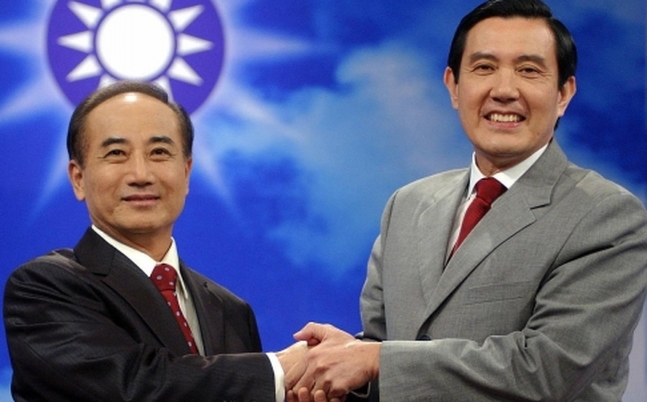
Legislative Yuan Speaker Wang Jin-pyng turns down an offer to be the vice-presidential candidate on the KMT ticket, as Ma Ying-jeou looks on, May 31, 2007.
What motivated President Ma to attempt to expel Wang Jin-pyng from the KMT last September? One possibility is that Ma was genuinely troubled by the compelling evidence in the influence-peddling case brought against Wang, and saw the revelations as a moment to take a stand against corruption within the KMT’s legislative caucus. It’s hard to square this theory with the inconsistent reaction of Ma to other cases of scandal in the KMT, though, as this blog post by Frozen Garlic notes.

Another possibility is that the dispute was personal. There’s ample evidence of a long-running Ma-Wang rivalry that goes back at least to the party chairman’s election in 2005, when Ma trounced Wang with over 70 percent of valid votes. As Ma prepared to run for president, Wang declined an invitation to run on the ticket as Ma’s vice president. So there may be some lingering animosity from this history. But this story isn’t very convincing, either. For one, savvy politicians rarely let personal feelings get in the way of political strategy—and those that do tend not to last in politics very long.

I think the answer lies elsewhere. If we think entirely in strategic terms, stripped of emotion and morals, there are two institutional reasons why Ma might have viewed Wang Jin-pyng in his role as speaker of the Legislative Yuan as a major impediment to his agenda, and thus sought to replace him with a more pliable figure.

1. Wang chairs the Cross-Party Negotiation Committee. The Cross-Party Negotiation Committee (in Chinese: 黨團協商, 政黨協商 or 朝野協商) is the body charged with resolving inter-party conflicts over legislative procedure. As this article details, it was created in the late 1990s in an attempt to reduce uncertainty and increase legislative efficiency, which had been disrupted by “wildcat” protests by opposition legislators. It came into force in 1999, the same year that Wang Jin-pyng became LY speaker, so its role is inextricably intertwined with Wang’s stewardship as the head of the legislature. 

As far as I have been able to tell, the CPNC is not well understood, even among Taiwanese political scientists who specialize in legislative politics. The basic rules (detailed here) are: 
  • Every party caucus (which requires a minimum of 3 members) is allowed one representative, typically the party caucus whip.  
  • The CNPC meets at the discretion of the LY Speaker; in practice this happens whenever there's a boycott or blockade in the legislature, which has happened at least 80 times in this LY.
  • Discussions are supposed to be recorded or otherwise made public; this rule is blatantly and routinely violated.
  • Any legislative action agreed to by all party representatives in the CNPC will not be opposed by individual members of each caucus, allowing for expedited reviews, votes, or other legislative actions.
I've not been able to identify any consensus about the ultimate effect the CPNC has on the conduct of legislative business. At one extreme, the CPNC could be working to formalize a minority party veto over all legislative action. That is, because all parties have to agree in the CNPC, even the smallest parties (the Taiwan Solidarity Union right now has only 3 members) could effectively block controversial legislation by withholding agreement in the committee.  That would require virtually everything to pass with the consent of all parties--an alarmingly high threshold for policy change.

At the other extreme, the CPNC could just function as a more formal version of the informal discussions that take place all the time between different parties in the legislature, and give no extra meaningful authority in practice to opposition parties.

The conversations I've had with people at the legislature suggest that the CPNC looks a lot more like the second situation than the first: to the extent negotiations in this body are meaningful, it is because the opposition parties are able to do things outside the CPNC to block majority action on legislation. And if negotiations in the committee actually were on the record, as the statute requires, the party leaders would simply move them out of that committee and somewhere else private.  Thus, the CPNC is not really the place where the president's agenda goes to die. If President Ma thought getting rid of Wang would gut the CNPC and streamline legislative action, he had the wrong target in mind.
2. Wang does not use police force to end opposition blockades.  Rather than in the Cross-Party Negotiation Committee, the opposition's power to block ruling party legislation lies primarily in its ability to occupy the speaker's podium, and thus to prevent legislative sessions from being gaveled in. As I noted in the previous post, this type of action is something like a filibuster, and it is not absolute; the KMT caucus ended one of these blockades by physically removing opposition legislators from the podium prior to the passage of ECFA in 2010. The inability of the KMT to repeat that success in recent months is probably because of dissension within the majority party caucus itself, rather than anything the opposition is doing differently.
Picture
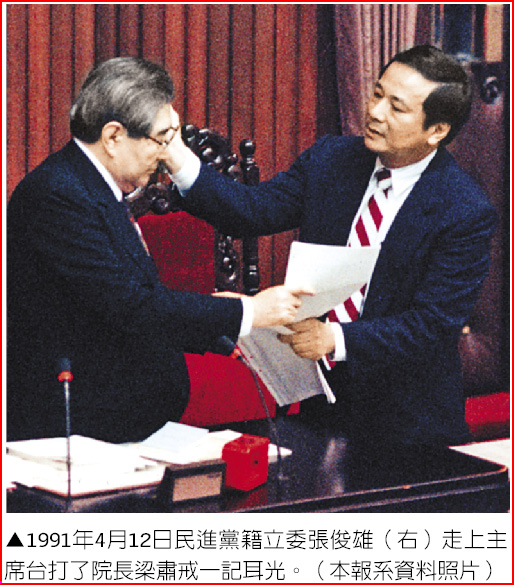
DPP legislator Chang Chun-hsiung (right) slaps Legislative Yuan Speaker Liang Su-jung at the speaker's podium, April 12, 1991.
A shoving match is not the only way the majority party could counter an opposition party blockade of the speaker's podium, however. The Speaker also has the authority to call in the LY's security force to restore order. As this article describes, the "sergeant at arms" power (警察權) has been used a total of six times, all before 1992 when the legislature was fully democratic (i.e. the majority of legislators were still permanent representatives of mainland China):
  • 1988.12.06: DPP legislators objecting to the continued presence of permanent unelected "Eternal Legislators" (萬年立委) try to grab the microphone from the speaker, Liu Kuo-tsai (劉闊才), starting a fight. Liu calls in the police and throws the DPP legislators out of the chambers.
  • 1989.07.04: As a protest against the unelected legislators, DPP legislator Wu Yung-hsiung (吳勇雄) stands at the presentation podium (發言台) and refuses to budge. Speaker Liu calls security personnel in to have him removed from the chamber.
  • 1990.05.29: Hau Pei-tsun, the sitting Minister of Defense and a retired military general, is nominated to be the next premier by President Lee Teng-hui. During the confirmation hearing, the DPP criticizes the nomination, calling Hau the head of a new “military cabinet” (軍人組閣). (Until 1997, premiers had to receive LY confirmation before taking office.) During the confirmation vote, a physical altercation breaks out between KMT and opposition LY members, and Speaker Liang calls in security to restrain the opposition.
  • 1990.11.06: DPP members are unhappy that Speaker Liang permits Premier Hau to give perfunctory answers to legislators (“敷衍兩句“). A fight breaks out while Hau's remarks are being read into the official record, and Liang again calls in security to quash the opposition’s protests.
  • 1990.12.18: Upset at the KMT caucus's sudden change to the legislative agenda, the DPP caucus starts a group protest, and DPP legislator Wei Yao-kan (魏耀乾) unplugs the microphone while Speaker Liang is attempting to start the session. For the third time in a year, Liang calls in security personnel, who struggle to restrain DPP legislators and restore order. 
  • 1991.04.12: The best-known incident: DPP legislator and future premier Chang Chun-hsiung (張俊雄) approaches Speaker Liang at the podium, hands him a letter of protest, and then without warning lightly slaps him, telling him that this is a “wake-up call” from the Taiwan people. Furious, Liang orders security into the chamber. DPP legislator Lu Hsiu-yi (盧修一) rushes to defend Chang, ends up injured at the bottom of the scrum with the police, and is sent to the hospital. A few moments of the confrontation can be seen in the video accompanying this news story.

Given these precedents, then, during any of the dozens of times the opposition parties have occupied the podium over the last year, Wang could have used this power to have them removed. And this presumably would have allowed action on everything on President Ma's agenda, including the Cross-Strait Services in Trade Agreement. So in a strictly legal sense, Speaker Wang has not used every weapon in his arsenal to ensure legislative action on executive priorities. He is allowing the opposition to block legislation without consequences. From Ma's perspective, then, a speaker more sympathetic to the president's agenda could use this power to end opposition blockades--thus, in all probability, the attempt to get rid of Wang. 
Picture
Speaker Wang, still banging away.
Ma Might Think Getting Rid of Wang Will Tame the Legislature. It Won't.
If we view the Speaker's authority over the legislature in its historical context, the picture is not nearly so simple. First, the sergeant-at-arms power has never been used in the democratic era. Taiwan today is a strikingly different place from Taiwan in 1991: most obviously, all legislators are subject to direct elections now. Calling in the police would be the political equivalent of dropping a nuclear bomb on the legislature. The opposition would no doubt go all-out to resist a police action in the legislative chambers and to play up the violence and drama, and the image of security forces dragging out opposition legislators would attract not only blanket domestic news coverage but probably also a great deal of opprobrium from abroad as well. 
 
It's also just not Wang's style--he's been able to survive as speaker in large part because he's viewed as a fair-minded and consensus-oriented leader, one of the few people who is well-connected and respected among both political camps. And even if Wang were in theory willing to entertain the idea, the fate of the last speaker to call in the police should give him pause: Liang Su-jung lasted barely over a year in the position before he had to resign. 

It's conceivable that, had Ma succeeded last September in expelling Wang from the party and creating a vacancy for the speaker's office, a Ma ally could have been installed in the position--someone like the KMT caucus whip Lin Hung-chih (林洪池). But he would face the same basic dilemma: he doesn't have the internal party unity to win a showdown with the DPP, and using the police to remove opposition legislators would impose a huge political cost. I'm skeptical that the KMT caucus would agree to bear that cost, or that they would support a nominee for speaker who was willing to impose it. 

Thus, removing Wang Jin-pyng from the Speaker's position was not likely to change the underlying situation much. Even if it had succeeded, I think Ma's attempt to purge Wang was a serious strategic miscalculation, and indicates a fundamental misunderstanding of how the legislature works.    
2 Comments

Ma vs Wang, Lesson 2:  The KMT legislative caucus is Ma Ying-jeou's primary opponent

9/21/2014

0 Comments

 
For the previous posts in this series, see here and here.
Picture
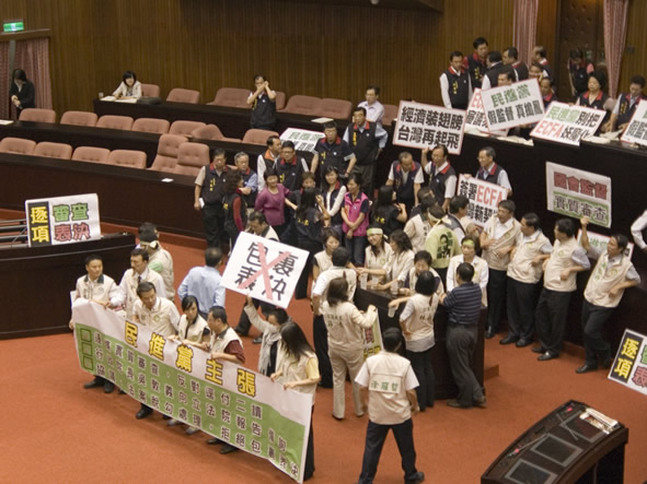
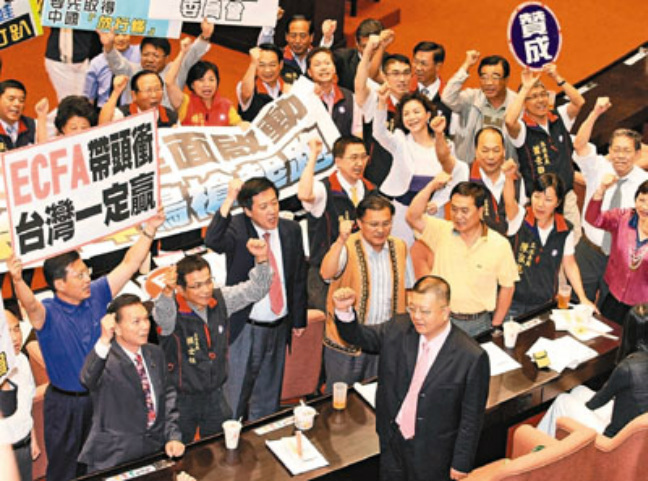
Readying for battle: pan-Green and pan-Blue legislators wave competing signs before the opening of the legislative session, July 8, 2010.
Legislative Yuan Politics: Tyranny of the Minority?
For the last year, the fight over the Cross-Strait Services in Trade Agreement (CSSTA, or Fu-Mao for short) has taken center stage in Taiwanese politics. Although Fu-Mao has been the top policy priority of the Ma administration since it was signed June 21, 2013, it remains under review by the Legislative Yuan. Improving the prospects for Fu-Mao passage was probably the primary motivation behind the attempt to expel Legislative Yuan Speaker Wang Jin-pyng from the KMT. The opposition Democratic Progressive Party (DPP) and its nominal ally, the Taiwan Solidarity Union (TSU), devoted much of their time working to slow the review process in the legislature, from initiating a physical confrontation in the LY over how the agreement would be reviewed, to demonstrations in hearings, to using parliamentary tricks to upset committee sessions. By the time Chang Ching-chung (張慶忠), the convener of the Internal Administration Committee, unilaterally announced that Fu-Mao had passed the committee in the now-infamous "30-second review" on March 18, 2014, the agreement had already languished for nine months.

The apparent success of the pan-Green parties in blocking Fu-Mao, despite not holding anything close to a majority in the legislature (the DPP and TSU together have only 43 of 113 seats, or 38%), suggests at first glance that a highly motivated minority can exercise de facto veto power over all legislative business. How you feel about that probably depends on your view about cross-Strait trade agreements: -pan-Blue types (i.e. pro-KMT) tend to think of this as a "tyranny of the minority" and a terrible affront to the democratic principle of majority rule, while pan-Green types like to characterize it as a heroic, nation-saving stand in the face of a ruling party captured by Chinese interests. But if we step away from the particular issue of Fu-Mao, and think about what's best for Taiwan's democracy in the abstract, allowing minority parties an effective veto over anything they don't like is troubling. 

Imagine if the partisan roles were reversed. In fact, let's take a DPP dream scenario: say, a hypothetical President Tsai Ing-wen taking office in 2016, and enjoying a newly elected pan-Green majority in the legislature, attempts to win legislative approval for a special budget to purchase a new arms package just approved by the U.S. Then imagine the opposition pan-Blue parties, despite controlling only a minority of the seats, effectively blocking this proposal, as they did several times (with a majority) during the Chen Shui-bian administration? If you're a pan-Green supporter, you're very quickly going to change your tune about minority party rights and heroic boycotts and blockades, no?  So, if minority parties really are able to exercise a de facto veto in the legislature, that does not bode well for coherent policy change in a place whose political elites are highly polarized over anything to do with cross-Strait relations. You're effectively stuck with the status quo.
PictureKMT legislators celebrate the passage of the Economic Cooperation Framework Agreement (ECFA) in the Legislature, August 16, 2010.
Minority Party Obstruction Requires Majority Party Dissent
Now, let me strike a more optimistic note: I do not actually think the opposition parties have an effective veto over everything in the LY. On the contrary, in President Ma's first term, the Economic Cooperation Framework Agreement, which created the foundation for subsequent cross-Strait agreements like Fu-Mao and was also fiercely opposed by the DPP and TSU, passed the legislature only six weeks after it was signed. 

What the approval of ECFA indicates to me is that a president can get his priorities passed by the LY, even in the face of opposition party boycotts and blockades, if two conditions hold: (1) his party has a working majority, and (2) his own party's legislators are willing to vote the party line. What Ma is missing right now on Fu-Mao is the second: support from KMT legislators. In other words, the key disagreement over Fu-Mao right now is within the KMT, not between the Ma administration and the DPP or Speaker Wang.

This claim is not obvious, and it's more of a working hypothesis than a firm conclusion. But from conversations with political insiders and a close reading of actions in the LY, I'm increasingly convinced there was, even a year ago, significant opposition in the KMT's legislative caucus to Fu-Mao--enough opposition, in fact, that the agreement would probably have been rejected if the vote were secret. 

Why is the KMT, rather than the obstructionist tactics of the DPP, key to explaining the failure of the legislature to approve Fu-Mao? Because those tactics are only effective if the majority party isn't well-organized or committed to counter them. For instance, take the primary weapon the opposition uses: blockading the speaker's podium (霸佔主席台), which physically prevents Speaker Wang from gaveling in the legislative session (which normally happens every Tuesday and Thursday at 9am when the legislature is in session). This action is, roughly speaking, the Taiwanese version of a filibuster. Without a formal commencement of the legislative session, no LY business can be conducted, and actions such as the review of Fu-Mao cannot commence.

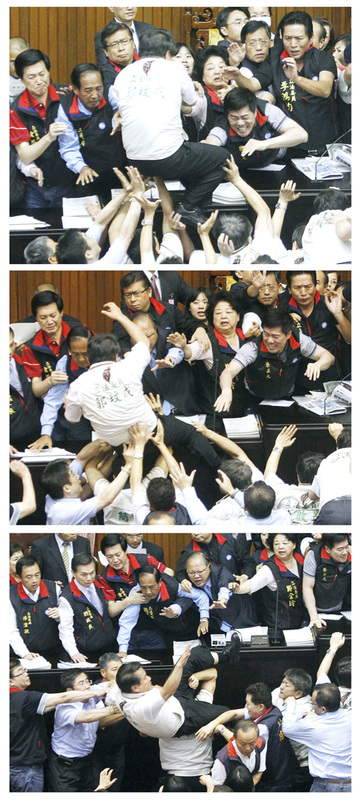
So what's to prevent the minority parties in the legislature from doing this all the time? The majority party tactic that's been used in recent years is to have a physical confrontation in the legislative chamber with blockading opposition legislators. As crazy as this might sound to the uninitiated, the majority party can clear a path to the podium by rallying all of its members to the LY floor and shoving the opposition out of the way in what looks like a rugby scrum. The video shown here (also see the photo at left) is an example of a successful effort.

It's easy to get so distracted by all the chaos and the spectacle of elected legislators throwing things at one another that you miss the critical outcome of this scrum: Speaker Wang gavels in the session to begin the second reading of ECFA. (One can just make him out at the back of the crowd, waiting for a path to clear. The video shows more of the sequence.) The KMT caucus then votes down a series of motions by the DPP to stall or to make ECFA subject to an item-by-item review. 
Picture
A phalanx of KMT legislators work to force DPP members out of the speaker's podium and end the minority blockade of the legislative session. Speaker Wang Jin-pyng subsequently gaveled in the session, and the Economic Cooperation Framework Agreement proceeded to the second reading, July 8, 2010.
Eventually, Speaker Wang worked out a procedural compromise in which the opposition DPP was allowed to offer amendments to each ECFA article, and the KMT then voted them all down, before the full bill was passed on August 17. This worked out okay for everyone: the DPP got a face-saving way to yield to the KMT majority, which was going to pass the bill one way or another; the KMT caucus got to avoid more fights on the floor; President Ma got ECFA approved; and Wang got to play peacemaker. 

If you think about it a bit, these kinds of physical confrontations shouldn't happen very often. They impose a cost on everyone: they attract a lot of negative media attention to the institution (including from CCTV in China!), people get hurt, etc. So there's an incentive for all sides to work out a compromise that precludes a public confrontation on the floor. The reason this doesn't happen all the time, I would guess, is uncertainty: neither party knows just how credible any given threat is by the KMT to initiate a confrontation in the LY and end a blockade. In the ECFA case, the July 8 showdown ended any uncertainty that the KMT would be able to mobilize its caucus to defend the speaker and end the blockade of the podium--in other words, that almost all KMT legislators supported ECFA and were willing to do whatever it took to get it passed. Once that became common knowledge, the DPP had only symbolic options left, like walking out of the legislative session in protest and getting an article-by-article vote it knew it would lose.
Picture
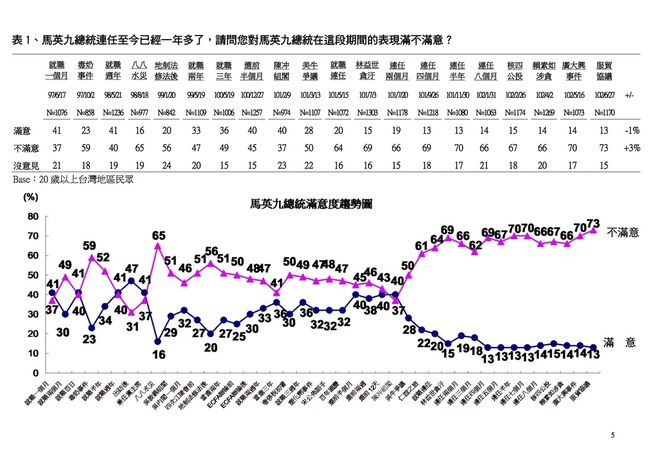
Second Term Blues: President Ma's approval rating, June 2008-June 2013
Between a Rock and a Hard Place (進退兩難): For KMT Legislators, Fu-Mao is not ECFA
So that brings us back to Fu-Mao, the Cross-Strait Services in Trade Agreement (CSSTA). If the KMT managed to get ECFA through the legislature in six weeks in 2010, then why wasn't it able to do the same for Fu-Mao in 2013? Nothing fundamental has changed in the legislature: the KMT lost some seats in the last election, but the party still has a significant majority (64/113, or 57%), even discounting the four additional legislators from the People First Party and Non-Partisan Solidarity Union who in general have voted with the KMT. The DPP and TSU are still quite solidly in the minority.

What has changed is public opinion, both toward President Ma and cross-Strait trade relations. When ECFA was signed in June 2010, Ma's public approval rating was about 47%--not great, but reasonably high given that Taiwan's economy was recovering from a severe recession that began almost as soon as he came into office.  Public support for ECFA was also positive: a TVBS survey in May 2010 found 41% of respondents approved of signing the agreement, while 34% disapproved.

By contrast, shortly after Fu-Mao was signed in June 2013, TVBS found public opinion running against the agreement, 47-30%, and Ma's approval rating at only 13%, with an astounding 73% of respondents disapproving of his performance, an all-time high. This was before any of the events of the subsequent year, including the Ma-Wang fight and the Sunflower Movement.

Given these polling numbers, it's not hard to see why support for Fu-Mao in the KMT caucus might have been a lot weaker than the party elites wanted to admit. Not only did legislators have to worry about all the criticism coming from industry groups and constituents within their districts. They also had to worry about the electoral consequences of taking a public stand in favor of an unpopular trade agreement with China, while going out on a limb for an even more unpopular president who's spent most of his time in office keeping them at arm's length. But Ma is still the party chairman, and has repeatedly indicated he's willing to discipline KMT members who don't toe the party line on this issue. That's the definition of being stuck between a rock and a hard place (進退兩難). 

So then the DPP comes along and blocks the speaker's podium, and dissenting KMT members have an escape hatch: publicly say nothing so as not to violate party dictates, but privately avoid being anywhere near the legislature when it comes time for a show of force to get the DPP to stand down. It's not a coincidence that there was another major showdown at the speaker's podium on June 25, 2013, shortly after Fu-Mao was signed on June 21. This one did not go so well for the KMT, or at least for Ma's allies: after six hours of altercations, the parties agreed to an extensive item-by-item review of Fu-Mao, against the wishes of the Ma administration. Buried in the news reports of this confrontation are two revealing differences with ECFA. First, the KMT leadership itself started the standoff by ordering legislators to try to secure the speaker's podium at 6:30am, to preempt pan-Green legislators who were planning to do the same. Second, they failed, in part because there were many fewer KMT legislators present than in 2010--note the failure to block off the back door. I'm willing to bet there are a few KMT members who were secretly thrilled with this outcome, because it got them off the hook from having to support an unpopular agreement or else face party discipline.
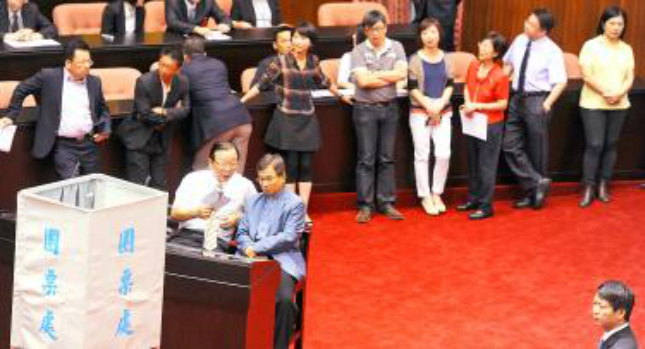
PictureDPP legislators block access to the voting box in the legislature, preventing a vote on Control Yuan nominees, July 4, 2014
I should reiterate that a lot of this explanation is informed speculation on my part. But even if I've got some of the details wrong, the fact remains that KMT legislators have been quite willing recently to criticize and vote against the party leadership on many different issues, especially if the votes are not public. The most striking instance of this kind of mass defection from the President's camp came just a couple of months ago over Control Yuan nominees. There was a rather bitter dispute between Ma and his allies in the LY, on one side, and what appeared to be the opposition DPP again, on the other, over how Control Yuan nominees would be voted on. Ma wanted to impose a public vote, because he was (rightly) worried that many of his nominees would go down to defeat otherwise. The pan-Greens instead demanded a secret vote. In the end, the DPP and TSU physically blocked access to the ballot boxes set up in the LY chambers, and then occupied the speaker's podium again; this strategy succeeded in forcing the vote to be carried out individually with private ballots, without the "group voting" that Ma's allies had initially devised to keep KMT members in line. And lo and behold, 11 of the 29 Control Yuan nominees were voted down--an outcome that could only have happened with at least eight "no" votes from KMT members. 

Politics in the Legislature: Messy, but Responsive to Public Opinion
Let me sum up what is now a rather long post. I've argued that there are some important strategic reasons behind all the spectacle of fights and occupations in the legislature:
  • The Taiwanese legislature features a limited minority veto;
  • When the majority party is cohesive and disciplined, minorities can't generally stop things they oppose;
  • But when there's dissent within the majority party, minority party obstruction becomes highly effective.
Thus, the Ma administration has been in a bind much of his second term: he wants to get legislative approval for Fu-Mao and other policy priorities, but these are unpopular, and so is he. And he's been unable to threaten or cajole KMT legislators into doing what it takes to overcome DPP opposition. What we've seen play out over the last year and more is at heart a consequence of Ma running up against his limited authority over the LY, even though he's the chairman of the majority party there. 

If you buy this argument, then the implication for democracy in Taiwan is a lot better than I implied in the last post: minorities in the LY don't generally exercise vetoes over everything they don't like, and majority parties, especially when they have public opinion on their side, can indeed get controversial things passed. It's only when public opinion is running strongly against something the executive wants that it's likely to stall in the legislature. And if you think elected representative parliaments should be broadly responsive to changing public opinion, then that's probably a good thing.

0 Comments

Ma vs Wang, Lesson 1: The Legislative Yuan matters more than ever for policy-making in Taiwan

9/19/2014

0 Comments

 
For the intro post in this series, see here.
Picture
The old days of executive dominance: premier Hau Pei-tsun orders Chen Shui-bian, then a DPP legislator, back to his seat in the Legislative Yuan, Oct. 21, 1992.
For most of Taiwan's postwar history, policy-making was highly centralized in the Executive Yuan and the KMT itself. The Legislative Yuan, by contrast, was mostly a talking shop that rubber-stamped government budgets and initiatives. That began to change with democratization, but it's been a slow process. Even today, the annual budget proposal is drafted by the executive, and the legislature is prevented from adding new spending--the only way for legislators to affect this process directly is to cut funding, or freeze funds once they've been appropriated.

Nevertheless, the legislature has steadily accumulated authority at the expense of executive ministries over the last two decades. The ability of opposition party legislators to make life tough for executive branch officials became especially apparent in the later years of the Chen Shui-bian administration, when a pan-Blue (KMT-PFP) alliance held a relatively unified majority of the seats in the LY. Legislative committee inquisitions of ministers were common, key bureaus had budgets cut or frozen for transparently partisan reasons, and much of the government's proposed legislation (with key exceptions) was blocked. 

At the time, the standoff between the two branches appeared due almost entirely to the intensely partisan atmosphere that prevailed from 2004-2008. Thus, when Ma Ying-jeou won the 2008 election and the KMT won over 3/4 of the seats in the LY, most observers expected executive-legislative relations to become much more cordial and cooperative again. And for Ma's first term, they seemed to be improved, although even then there were complaints about LY "inefficiency" at passing high-priority legislation.

But legislative independence has reemerged with a vengeance in Ma's second term, even though the KMT remains the majority party there. What is so striking about the events of the last year and more is that even in a period of "unified" party control of both branches, the LY has prevented a quick passage of the president's top policy priority--the CSSTA--and may have killed it for good. That is not an outcome that I would have predicted in 2012, when Ma was re-elected. 

From a systemic perspective, what's potentially more troubling is that the current situation is about the best a governing party in Taiwan could ever hope for: the KMT controls the presidency and a majority in the legislature, and the president is the chairman of the party. The unity of purpose across the branches should be highest in this scenario. If a president can't get his agenda approved by the legislature under these circumstances, when can he?
0 Comments

Ma vs Wang, One Year Later

9/19/2014

0 Comments

 
Picture
Legislative Yuan Speaker Wang Jin-pyng and President Ma Ying-jeou, playing nice for the cameras
Although it passed mostly unnoted in the Taiwanese media, last week marked the one-year anniversary of the (failed) attempt by President Ma Ying-jeou (馬英九) to expel Legislative Yuan Speaker Wang Jin-pyng (王金平) from the KMT. It has also been about a year since I started blogging regularly on Taiwanese politics, so the Ma-Wang fight featured prominently in my first posts.  At the time, I hadn’t paid much attention to intra-KMT politics or executive-legislative relations, and I quickly realized there was a lot I didn't understand. My working assumption had always been that because the KMT controlled a comfortable majority in the legislature, and President Ma was the chairman of the KMT, he could probably get most of what he wanted approved there. 

The sudden attempt to purge Speaker Wang suggested that executive-legislative policy-making was more complicated, and more interesting, than I had supposed. And the slow, foot-dragging review of the Cross-Strait Services in Trade Agreement (CSSTA) (兩岸服務貿易協議) --"Fu-Mao" for short--in the legislature put the lie to the idea that President Ma could ultimately wield control over the KMT to get executive priorities passed.  It eventually became clear that these two events were probably linked: that Ma's strike against Wang was motivated at least in part by his frustration with the slow pace of action on the CSSTA in the legislature. 

All this happened well before a procedural dispute sparked the student protest and occupation of the legislature that became known as the Sunflower Movement. Thus, while the student protests were unexpected and dramatic, and attracted a huge amount of foreign and domestic media attention, their main political achievement so far is to have reinforced the pre-existing stalemate between the legislature and the executive. The focus on the light and heat generated by the Sunflower Movement has, I think, obscured this fact: the legislature as an institution is a formidable and powerful opponent of the executive. 
Picture
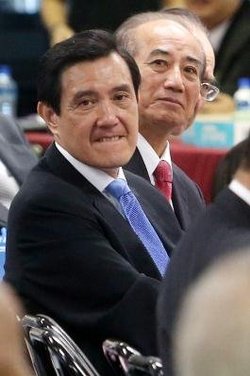
Ma and Wang at the KMT party congress, September 15, 2014.
The narrative of the Ma administration is that the legislature is dysfunctional, and that the opposition Democratic Progressive Party (DPP) is entirely to blame for the ruling party's troubles. At the KMT's party congress  this past week, for instance, President Ma criticized the DPP for its "endless" obstructionism and "abuse" of minority power. 

If the main opposition party in the legislature really does have the ability to block everything it doesn't like, then that is indeed worrisome for Taiwan's democracy. But it's not as simple as that. The DPP, for all its success in harassing cabinet officials and stalling government initiatives, is not able to exercise an effective veto over legislation as long as the KMT itself is unified. Thus, I think the fundamental political problem for Ma lies not with the opposition but within the KMT itself. 
In posts over the next few days, I'm going to elaborate on this claim, along with some thoughts on what it means for Taiwan's democracy. In particular, I think the events of the last year have demonstrated four things:
  1. The Legislative Yuan matters more than ever for policy-making.
  2. The KMT legislative caucus is the primary obstacle to presidential priorities--not the DPP, the Cross-Party Negotiation Committee, or Wang Jin-pyng.
  3. President Ma thought removing Wang Jin-pyng would solve his problems with the legislature. It won't.
  4. The Ma administration doesn't understand the politics of the legislature very well.

Separate posts will follow.
0 Comments

Some Useful Statistics about Taiwan's Economy

7/28/2014

0 Comments

 
One of the nice things about studying Taiwan is that it has a top-notch statistical bureau, with lots of high-quality economic data made readily available to the public, if you know how to access it.  These data are really an underutilized resource in scholarship on Taiwan, which often cites cursory or incomplete statistics reported in the media that can give a misleading impression of the overall state of the economy (for an example, see this Taipei Times write-up of unemployment trends.)  

As a way to keep track of some of these data, I thought I'd post a couple figures I made a while back for a talk, along with the sources. I'd encourage anyone who's interested and can read some Chinese to explore them further at the ROC National Statistics homepage, here.

Picture
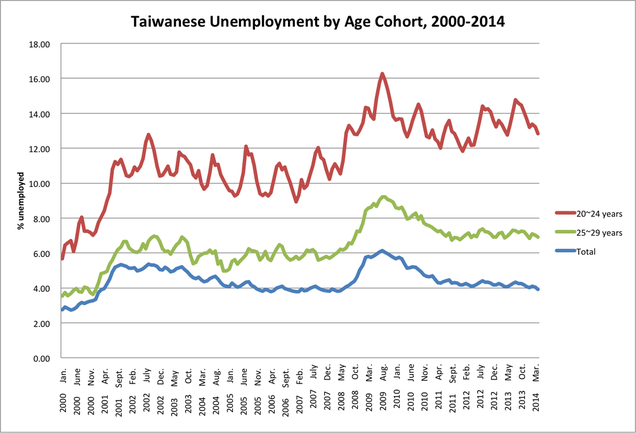
Source data: ROC Statistical Bureau.

First, in the figure above I've broken out unemployment level by age cohort, focusing on the two key "youth cohorts" (I've left out the 16-19 category, which can be misleading given that many people are not actively looking for work at this age). It's striking how much higher youth unemployment is than overall unemployment, which by international standards is quite low at about 4%. By contrast, unemployment in the 20-24 year age cohort is more than triple that, at near 13%.  Equally interesting, and easier to miss, is that the gap between the young cohorts and the rest has also increased over the last 14 years: that difference was a factor of two in 2000, but a factor of over three in 2014. This figure gives us some sense of why the forceful opposition to the cross-Strait Services in Trade Agreement (CSSTA) included so many students: they've done proportionately worse over the last decade and more, even as the total labor unemployment rate has returned to a level near what it was a decade ago. 

Picture

Source data: World Bank, and ROC Statistical Yearbook.

Picture
Source data: World Bank and ROC Statistical Yearbook.
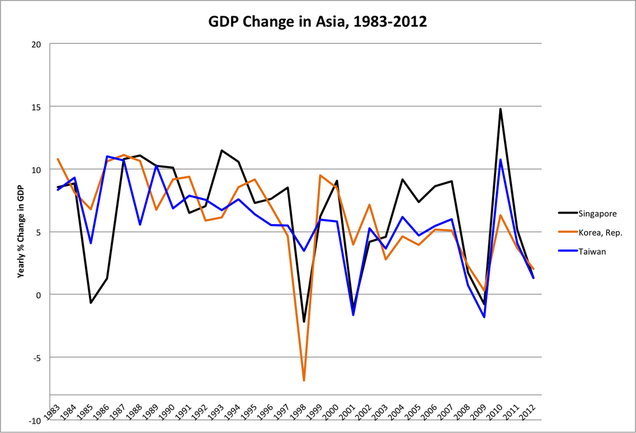
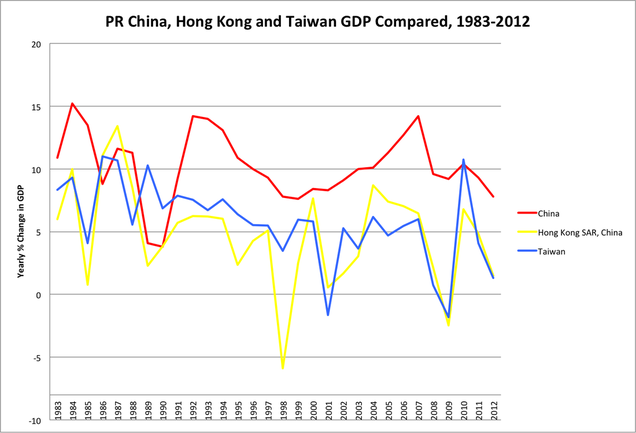
Second, the figures above show GDP change in several economies to which Taiwan's is often compared.  The presentation is a little messier than I'd like, but one can still get a good sense of how Taiwan's economy has performed in relative terms over the last 30 years.  

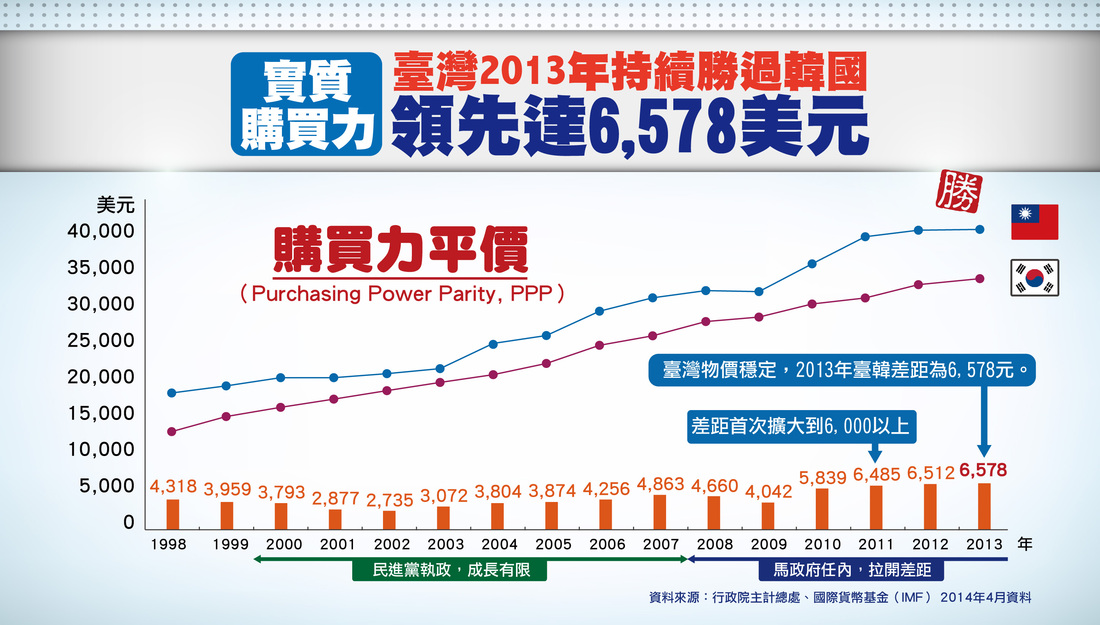
What's especially striking to me is the recent comparison with South Korea. The narrative of the Ma campaign in 2008 was that Taiwan's economy had drastically underperformed and was losing ground. By contrast, the data above show that, at least using GDP growth rates, Taiwan's growth was higher than Korea's for five consecutive years, from 2003-2007. (The economic shock that hit all of East Asia in 2008-09 originated in the United States, so it's hardly fair to blame either Chen Shui-bian or Ma Ying-jeou for the deep recession that followed.) But that generally positive story about the Chen years (2000-2008) gets turned into this (from the KMT's party website):

Picture
That is, the KMT is attempting to lump the entire eight years of the DPP presidency together, in which the gap between Taiwan and South Korea narrowed, and contrast them with the increasing rates of the subsequent Ma administration. At best, that's an incomplete picture, as the data in the first two tables demonstrate. While the gap narrowed, it did so during Chen's first term, not his second. And the increase in the Taiwan-Korea gap during the Ma years is due entirely to a giant spike in 2010, when Taiwan's economy rebounded much faster from the recession than did Korea's.  

One other point: this is a pretty rudimentary comparison. Average per-capita income growth can also be misleading, in that rapid income growth among a small elite can move the whole average up. (In fact, that is what appears to have happened: as this article notes, average wages for salaried workers are about the same as they were in 1998, adjusted for inflation.) It would be nice to see median salary, and even better, a comparison of income inequality and its cousin, wealth inequality, measured various ways over time. 

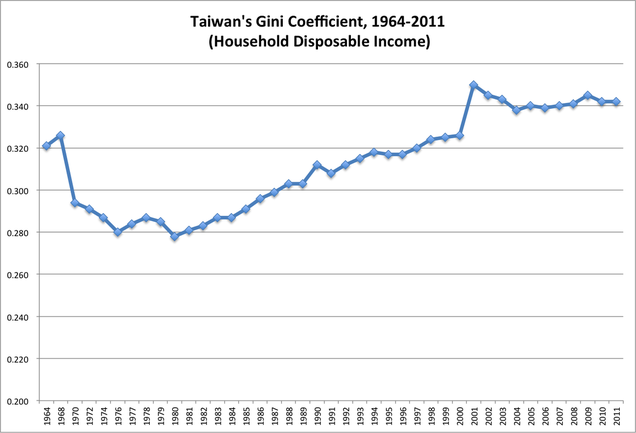
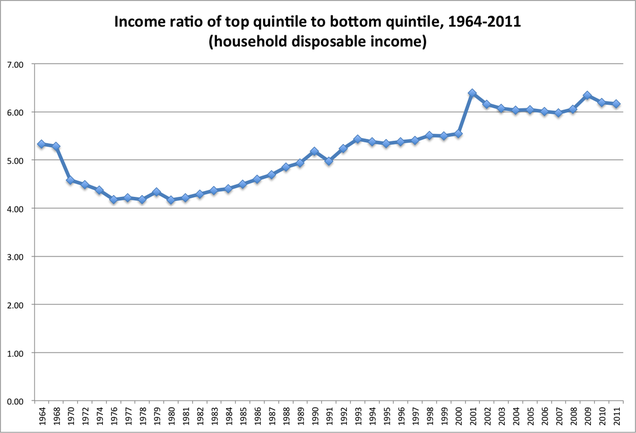
The first of these, income inequality, is shown in the figures below.

Picture
ROC Statistical Bureau source data

Picture
ROC Statistical Bureau source data

The last two figures show income inequality measured two different ways: as a Gini coefficient, and as a ratio of the top 1/5 to bottom 1/5 of all households. The pattern in both graphs is similar: Taiwan's income inequality was on a pretty steady upward trajectory from 1980 until 2000, then it leveled off.  (The spikes are during the recessions of 2001 and 2008-9, when unemployment jumped, driving income inequality higher during these periods.)  

This picture is surprising given the narrative in the media about rapidly increasing inequality in Taiwan--so surprising I'm not entirely sure what's going on here. I suspect using income instead of wealth is painting a much better picture of inequality than actually exists on the ground. For one, capital gains and real estate gains are not treated like ordinary income for tax purposes in Taiwan--if a household's wealth gains come mostly from these sources, then they are potentially classified as low-income! For another, the use of quintiles in the comparison above, rather than five percent margins (as reported in this article), or even something smaller like comparing gains to the top 1% or top 0.1%, would probably paint a starker contrast.  At any rate, worth investigating further, given how prominent this issue is becoming in public discourse in Taiwan.  Grist for a future post...

0 Comments

A Model for Taiwan?: West Germany, 1969

4/18/2014

0 Comments

 
Picture
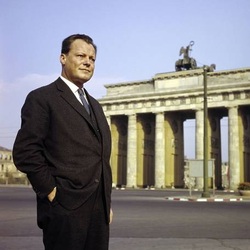
As an alternative to the way cross-Strait policy has been dealt with (or rather, not dealt with) in Taiwan over the last year, I've been thinking a lot about how similar foreign policy or trade controversies have historically been resolved in other democracies.  One example I like a lot comes from the former West Germany. 

Ostpolitik: Procedural Legitimacy, German Style
In 1969, West Germany had been a democracy for less than 20 years*.  In a situation with some striking parallels** to Taiwan's current one, the newly-elected Social Democratic chancellor Willy Brandt pushed for a policy of engagement rather than confrontation with the communist East Germany and its Soviet patron. Under this so-called Ostpolitik, or "eastern policy,"  Brandt signed a series of treaties renouncing the use of force, recognizing post-war European borders, establishing diplomatic recognition of Warsaw Pact states in eastern Europe, and culminating in a peace treaty, the Basic Treaty, with East Germany itself in 1972. 

Ostpolitik was hugely controversial in German political life.  Brandt was the first non-conservative to hold the chancellorship in the post-war era, and his sharp change in policy was fiercely opposed by the former ruling party, the Christian Democratic Union (CDU). After the Basic Treaty was signed in early 1972, several MPs from Brandt's coalition partner the FDP defected to the opposition, and it looked like Ostpolitik might be stalled or reversed. 

But in a crucial showdown in April 1972, the CDU fell two votes short*** of winning a no-confidence vote to replace Brandt's government with a conservative coalition. Seven months later, Brandt's coalition was re-elected in federal elections, and the treaty was then approved by the German parliament.  By winning both a no-confidence vote and an election after the Basic Treaty was signed, Brandt endowed his policies toward Eastern Europe with a great deal of democratic legitimacy despite the controversy.  Most impressively, when the CDU eventually returned to power in 1982, it retained Ostpolitik, which by that point was supported by all the major political parties.  

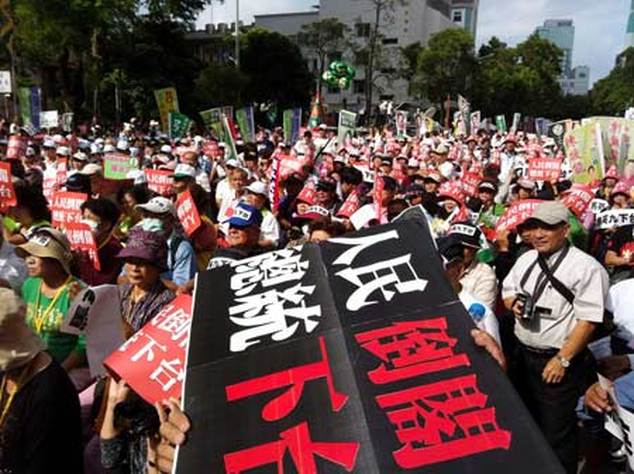
PictureProtestors outside the Legislative Yuan last October call for the president's resignation and a no-confidence vote against the Executive Yuan.
Why a German-Style Solution Isn't Available in Today's Taiwan
It’s instructive to consider all the ways Taiwan’s current institutions prevent a kind of “German solution” to the CSSTA controversy.  There are four big ones:

1.  Ostpolitik Agreements were Treaties.  The Basic Treaty signed by the Brandt government with East Germany was beset by ambiguity about the official status of the East German state: West Germany had claimed since partition to represent the entire German nation and refused to acknowledge the legitimacy of an independent East Germany (sound familiar?).  Brandt’s linguistic work-around was to assert that two states existed “in Germany,” but that they could not regard one another as foreign countries.  Nevertheless, when the Basic Treaty was signed, everyone agreed that it required parliamentary approval to take effect--like the Treaty of Moscow and Treaty of Warsaw before it.  

Unlike in the Taiwan case, the West German procedure for approving the Basic Law remained the same as for approving agreements with other foreign powers: an up-or-down vote in both houses of parliament.  In Taiwan, however, it's not clear whether the CSSTA even requires a vote in the Legislative Yuan, even though trade agreements with other countries do.

2. The Advantages of Parliamentarism (I): Executive Actions depend on Parliamentary Confidence.  As head of government in a parliamentary regime, Brandt’s actions implicitly depended on the continued support of a majority in the Bundestag, the lower house of the German parliament.  Ostpolitik, and especially the Basic Treaty, were controversial enough that Brandt nearly lost this majority.  Had the opposition CDU managed to win the no-confidence vote, Brandt would have been replaced by a new conservative coalition, and the Basic Treaty would likely have been modified or withdrawn.  

In contrast to the Taiwan case, there was an obvious institutional way to settle the conflict over Brandt’s policy: hold a vote in parliament. Brandt’s victory in that vote confirmed he still had the minimum support needed to advance the treaty.  In Taiwan, the legislature has a formal no-confidence power, but it's much weaker: it can be used only against the premier, not the president; it gives the president the right in turn to dissolve the legislature, so most LY members don't want to use it lest they have to face the voters in early elections; and it can only be used once every 12 months.  

Moreover, in a move that looks rather stupid in hindsight, the DPP brought a no-confidence measure against premier Jiang Yi-huah last October, which, given the KMT's majority, predictably failed badly.  So even if enough members of the LY were willing to risk early elections to bring down the premier and his cabinet, that option is closed off for the next six months.

3. Proportional Electoral Systems Make Coalition Governments Likely.  Since the founding of the FDR, Germany has almost always had stable coalition governments.  A key reason is the German electoral system, the so-called mixed-member compensatory system.  Under the German system, all parties which win over five percent of the party vote get a proportional share of seats in the lower house. Thus, for much of Germany’s postwar history, a small centrist party, the FDP, held the balance of power in the Bundestag.  Brandt relied on FDP support to stay in office; the vice chancellor and foreign minister under Brandt was the head of the FDP, Walter Scheel. When FDP members opposed to the Basic Treaty started defecting, the Brandt coalition was in trouble.  

In contrast, Taiwan’s 2005 electoral reform created a much more majoritarian electoral system: the KMT’s current majority in the Legislative Yuan is due in part to a highly disproportional conversion of votes into seats.  As a consequence, there is no coalition partner on which the KMT depends to get bills passed in the legislature, and no direct way for non-KMT parties to ensure they are included in the cabinet.*^

4. The Advantages of Parliamentarism (II): Early Elections.  Fourth, despite winning the no-confidence motion, Brandt was still in a precarious political position.  He had lost several members of his coalition, and it soon became clear that he no longer held a working majority in the Bundestag.  So, he called early elections: in November 1972, seven months after the no-confidence vote, German voters got to weigh in on the Brandt government and, by association, Ostpolitik.  The result of the polls left little doubt that Brandt had the support of a popular majority: both the SDP and FDP gains seats at the expense of the CDU. Brandt had for all intents received a popular mandate to continue with Ostpolitik.

Again, the contrast with Taiwan is stark.  There is no requirement that the Ma administration face the voters again before implementing the CSSTA. Nor can Ma call early elections even if he wanted to; that would require a no-confidence vote to pass the legislature, which, as I noted above, isn't even a constitutional option until October 2014.  In short, there's no easy way to have the voters weigh in directly on the current controversy or the Ma administration's performance until the 2016 general election--two years away.  The consequence is that the CSSTA controversy is likely to remain unresolved, exacerbating political gridlock in Taiwan until at least 2016.  It's hard to see that as a good outcome for Taiwan's democracy.    


* It might not be obvious at first glance, but this is roughly the same age as Taiwan's democracy today: the first elected postwar government in Germany took office in September 1949, and Taiwan has had a fully elected legislature since 1992 and a popularly elected president since 1996.  

** I should emphasize I do not mean to draw any lessons from this example about how cross-Strait rapprochement should proceed. I highlight this case only because of the admirable way in which a highly divisive foreign policy issue was resolved domestically to West Germany's long-term benefit, not because I think Taiwan-PRC relations should be handled in the same way.

*** The CDU lost the vote when two of its own members unexpectedly failed to support the party's motion.  After the unification of Germany in 1990, East German secret files revealed that both MPs were paid by the East German secret service to vote against the motion.

*^ In practice, the Cross-Party Negotiation Committee (政黨協商) in the Legislative Yuan gives minority parties the ability to slow or block legislation; it does not, however, give them any say in, or claim to, Executive Yuan cabinet positions, as a real cross-party coalition would in a pure parliamentary regime.
0 Comments

TDP Seminar: Roselyn Hsueh

4/12/2014

0 Comments

 
Picture
On May 5, 2014, the Taiwan Democracy Project will welcome Roselyn Hsueh to Stanford for a very timely talk on the politics of trade in Taiwan.  Dr. Hsueh is an assistant professor of political science at Temple University and a visiting scholar in the Religion, Politics, and Globalization Program at U.C. Berkeley.  Her talk is entitled, "Economies and Identities: The Politics of Taiwan's Globalization in the Age of China." The talk is free and open to the public, although you are encouraged to RSVP to [email protected].  The talk abstract is below.  UPDATE: The official event page is here.

Professor Hsueh's research focuses on the politics of market reform, comparative capitalism, development, and other areas of international and comparative political economy. Her publications include China’s Regulatory State: A New Strategy for Globalization (Cornell University Press, 2011) and “China and India in the Age of Globalization: Sectoral Variation in Postliberalization Reregulation,” Comparative Political Studies 45 (2012): 32-61. She received her Ph.D. from U.C. Berkeley and has served as a Hayward R. Alker Postdoctoral Fellow at the University of Southern California and conducted research as a U.S. Fulbright Scholar at the Institute of World Economics and Politics, Chinese Academy of Social Sciences. 


Economies and Identities: The Politics of Taiwan’s Globalization in the Age of China

For several weeks in March and April, university students in Taiwan camped out in the legislative and cabinet offices to protest the Cross-Strait Agreement on Trade in Services between China and Taiwan.  Joined by hundreds of thousands of Taiwanese, spilling out to the streets, the demonstrators claim President Ma Ying-jeou negotiated the agreement with China without seeking any public input and bypassing the legislative process entirely.  Implications of this historical social movement include the functioning of Taiwan’s democratic institutions, which have undergone regime change but democratic consolidation remains in question.  Additionally, a potential cross-strait crisis can affect U.S.-China relations in the post-Cold War era.  Two important forces are also at play: China’s meteoric playing-by-its-own-rules economic rise, and the evolving Taiwanese national identity after its transition to democracy.  This talk will center on the national-specific consequences of liberal trade and democracy for Taiwan’s economic globalization and political development.

0 Comments
<<Previous

    RSS Feed

    About Me

    I am a political scientist with research interests in democratization, elections and election management, parties and party system development, one-party dominance, and the links between domestic politics and external security issues. My regional expertise is in East Asia, with special focus on Taiwan.

    Posting on Bluesky @kharist.bsky.social

    Archives

    November 2025
    October 2025
    September 2025
    August 2025
    July 2025
    June 2025
    April 2025
    February 2025
    January 2025
    November 2024
    October 2024
    May 2024
    March 2024
    January 2024
    December 2023
    November 2023
    October 2023
    August 2023
    May 2023
    April 2023
    March 2023
    February 2023
    January 2023
    December 2022
    November 2022
    October 2022
    September 2022
    August 2022
    June 2022
    May 2022
    April 2022
    March 2022
    February 2022
    January 2022
    December 2021
    March 2021
    February 2021
    December 2020
    October 2020
    September 2020
    August 2020
    July 2020
    June 2020
    September 2019
    August 2019
    November 2018
    August 2018
    June 2018
    February 2018
    January 2018
    October 2017
    August 2017
    December 2016
    November 2016
    September 2016
    August 2016
    July 2016
    March 2016
    February 2016
    January 2016
    December 2015
    November 2015
    October 2015
    September 2015
    July 2015
    June 2015
    May 2015
    March 2015
    February 2015
    January 2015
    November 2014
    October 2014
    September 2014
    August 2014
    July 2014
    May 2014
    April 2014
    March 2014
    February 2014
    January 2014
    December 2013
    November 2013
    October 2013
    September 2013

    Categories

    All
    1992 Elections
    2008 Elections
    2012 Elections
    2014 Elections
    2016 Elections
    2020 Elections
    2022 Elections
    2024 Elections
    2026 Elections
    Aacs
    Aborigines
    Alex Tsai
    Alicia Wang
    Annette Lu
    Announcements
    Apsa
    Apsa Cgots
    Arthur P Wolf
    Artificial Intelligence
    Blog Meta
    Book Review
    Brookings Institution
    Campaign Regulation
    CCP
    CDDRL
    CEC
    Chang Ching Chung
    Chang Chun Hsiung
    Chang Jung-wei
    Chang Li-shan
    Chang Ming-ta
    Chang Sho-wen
    Chen Che-nan
    Chen Chien-nian
    Chen Chi Mai
    Chen Chin-te
    Chen Ding-nan
    Chen Fu-hai
    Cheng Chao-fang
    Cheng Cheng-ling
    Cheng Pao-ching
    Chen Kuang-fu
    Chen Kuan-ting
    Chen Ming-wen
    Chen Ou-pu
    Chen Shih Chung
    Chen Shih-chung
    Chen Shui Bian
    Chen Tsang-chiang
    Chen Wan-hui
    Chen Wei-chung
    Chen Ying
    Chen Yu-chen
    Chiang Chi Chen
    Chiang Chi-chen
    Chiang Ching Kuo
    Chiang Jui-hsiung
    Chiang-kai-shek
    Chiang Tsung-yuan
    Chiang Wan An
    Chiang Wan-an
    Chin Hui Chu
    Chou Chiang-chieh
    Chou Chun-mi
    Chou Hui-huang
    Chuang Suo Hang
    Chung Chia-pin
    Chung Tung-chin
    Citizen 1985
    Civil Society
    Conferences
    Control Yuan
    Council Of Grand Justices
    Cross-party-negotiating-committee
    Cross Strait Relations
    CSSTA
    Defense Spending
    Demography
    Developmental State
    Diplomacy
    Disinformation
    DPP
    DPP Policy Papers
    Eats
    Economic Security
    Economic Voting
    Electoral Geography
    Electoral Reform
    Electoral Systems Wonkery
    Energy Policy
    Eric Chu
    Executive Yuan
    Fan Yun
    Fellowship
    Frank Hsieh
    Freddy Lim
    Frida Tsai
    Fu Kun Chi
    Fu Kun-chi
    Germany
    Han Kuo Yu
    Han Kuo-yu
    Hau Lung Bin
    Hau Pei Tsun
    Henry Rowen
    Ho Kan-ming
    Hoover Institution
    Housing
    Hou You Yi
    Hou You-yi
    Hsiao Bi Khim
    Hsiao Bi-khim
    Hsieh Fu-hung
    Hsieh Kuo Liang
    Hsieh Kuo-liang
    Hsieh Lung-chieh
    Hsieh Sam Chung
    Hsu Chen-wei
    Hsu Chih-jung
    Hsu Chung-hsin
    Hsu Hsin-ying
    Hsu Shu-hua
    Hsu Ting-chen
    Huang Hong-cheng
    Huang Kuo Chang
    Huang Kuo-chang
    Huang Min-hui
    Huang Shan Shan
    Huang Shan-shan
    Huang Shih Ming
    Huang Shiou-fang
    Huang Wei-che
    Huang Yung-chin
    Human Rights
    Hung Hsiu Chu
    Hung Tzu Yung
    Hung Tzu-yung
    Influence Operations
    In Memoriam
    Internship
    James Soong
    Japan
    Jiang Yi Huah
    Job Market
    John Chiang
    John Wu
    Journal Of Democracy
    Judicial Yuan
    Kao Hung An
    Kao Hung-an
    Kawlo Iyun Pacidal
    Ker Chien Ming
    KMT
    Kmt History
    Ko Chih-en
    Kolas Yotaka
    Ko Wen Je
    Lai Ching Te
    Lai Ching-te
    Lai Feng-wei
    Lai Hsiang-ling
    Lee Chin-yung
    Lee Chun Yi
    Lee Chun-yi
    Lee Teng-hui
    Legal-wonkery
    Legislative Yuan
    Liang-kuo-shu
    Liang Su Jung
    Lien Chan
    Lii Wen
    Lin Chia-lung
    Lin Chih-chien
    Lin Fei-fan
    Lin Geng-ren
    Lin Hung Chih
    Lin Ming-chen
    Lin Tsung-hsien
    Lin Yang Kang
    Lin Zi Miao
    Lin Zi-miao
    Liu Chao-hao
    Liu Cheng-ying
    Liu Chien-kuo
    Liu Kuo Tsai
    Lo Chih Cheng
    Lu Hsiu Yi
    Lu Shiow-yen
    Martial Law
    Ma Vs Wang
    Ma Ying Jeou
    Media
    Media Freedom
    Min Kuo Tang
    Nationalism
    Natsa
    NCC
    New Power Party
    Nuclear Power
    Occupy LY
    Pingpuzu
    Political Economy
    Political Science
    PRC
    PTIP
    Publications
    Public Opinion
    Quality Of Democracy
    Ramon Myers
    Rao Ching-ling
    Recall Elections
    ROC Constitution
    Russia
    Saidai Tarovecahe
    Sean Lien
    Security Studies
    Semiconductor Industry
    Shen Hui-hung
    Shen Lyu Shun
    Simon Chang
    Song Kuo-ting
    South Korea
    Speaker Series
    Stanford
    Statistics
    Street Protests
    Su Ching-chuan
    Su Huan-chih
    Su Jia Chyuan
    Su Jia-chyuan
    Sunflower Movement
    Su Tseng-chang
    Taiwanese Economy
    Taiwan Journal Of Democracy
    Taiwan People's Party
    Taiwan Rural Front
    Taiwan Solidary Union
    Taiwan Studies
    Taiwan World Congress
    Terry Gou
    Testimony
    The Diplomat
    This Week In Taiwan
    Ting Shou Chung
    Tpp
    Trade Relations
    Trans Pacific Partnership
    Tsai Chi-chang
    Tsai Ing Wen
    Tsai Shih-ying
    Tsao Chi-hung
    Tsao Er-yuan
    Tseng Yung Chuan
    Tzu Chi
    Ukraine
    United Nations
    Uscc
    US Taiwan NextGen
    Us Taiwan Relations
    V-dem
    Wang Chien-hsien
    Wang Chung-ming
    Wang Huei-mei
    Wang Jin Pyng
    Wang Mei-hui
    Wan Mei-ling
    Wei Yao Kan
    Wellington Koo
    Weng Chang-liang
    Wild Lily Movement
    Wilson Center
    Wu Den Yi
    Wu Yung Hsiung
    Xi Jinping
    Yang Cheng-wu
    Yang Shi-chiu
    Yang Wen-ke
    Yang Yao
    Yao Eng-chi
    Yao Wen-chih
    Yosi Takun
    You Si-kun
    Yu Shyi Kun

    RSS Feed

Powered by Create your own unique website with customizable templates.