Kharis Templeman (祁凱立)
中文姓名:祁凱立
  • Home
  • Research
  • Teaching
  • CV
  • Blog
  • Taiwan Studies Resources

The Curious Case of the Taiwan People's Party, Part 4: What LY Roll-Call Votes Miss

7/20/2025

0 Comments

 
This is Part 4; for previous posts see Part 1, Part 2, and Part 3. 
Picture
The Speaker's Podium, ready for the next battle.
To recap the argument so far: The Taiwan People's Party (TPP) controls the critical voting bloc in the Legislative Yuan, but it has not maximized the leverage that voting bloc gives it. 
  1. It has not sought to obtain offices (LY speaker or deputy speaker, or cabinet positions) for its members. 
  2. It has not sought concrete policy concessions from either the DPP or KMT in return for its support. 
  3. It has not tried to maximize its appeal to the general electorate, and it has behaved like a pan-blue party rather than a centrist one. 
​
This behavior is puzzling! 

What Is the TPP Doing? 
I have argued that the TPP is trying to bring about a partisan realignment within the pan-blue camp, away from the KMT. This is the only goal for which the TPP’s current strategy appears rational. It's an unusual strategy, but one that makes some sense given the political constraints the party faces.

Taiwan’s electoral institutions and party system present a high barrier to third-party growth. There is high party system institutionalization and politics and voting are now quite nationalized. The electoral system is permissive enough to allow small parties to gain a foothold in city councils and in the party list vote for the legislature, but they can never expand beyond small-party status unless they replace one of the Big Two. And no small party has ever succeeded in doing so in 30+ years of democratic elections.
 
So, to try to replace the KMT, the TPP needs to do two contradictory things at the same time.
  1. Convince pan-blue voters they are one of them, and in particular, to appeal to older KMT supporters while holding onto their younger base.
  2. Undermine the KMT, to change beliefs about the long-term viability of that party and convince their supporters that the TPP, not the KMT, is the future.

Now, if you were leading the TPP, how might you go about this? Toward the first goal, you'd pursue a public strategy of alignment with the KMT, especially on issues that you think make the DPP look bad. And toward the second, you'd quietly block legislation that would strengthen the KMT's grassroots or increase its popularity. 

Evidence for the first part of this strategy is obvious: Huang Kuo-chang is appearing in public regularly with the KMT, the TPP is publicly opposing the recall elections against KMT legislators, and (almost) everything controversial that has made it to a final vote in the LY has passed with joint KMT-TPP support over DPP objections. 

But what about the second? Can we find evidence of divergence of interests between the two party caucuses? This is harder to spot, because the TPP doesn't want KMT supporters to notice that it is trying to undermine the party's prospects. The TPP would rather be characterized as "marching in lockstep" with the KMT in its opposition to the DPP government, and everything else that matters to the KMT. 

But I don't think this is actually true.

Is the TPP Really Supporting Everything the KMT Wants in the LY?

Picture
Clearly, the engines and cockpit need to be reinforced.
To begin to see why this claim might be wrong, we need to talk about survivorship bias. Survivorship bias is the logical error of focusing on outcomes that survived a selection process, while overlooking those that did not. The classic example used to illustrate this form of bias comes from the Allied bombing campaign in World War II. The U.S. military did a systematic study of planes returning from bombing missions to try to understand how to improve aircraft survival while under fire. The study noted that certain areas like the wings and fuselage had more bullet holes than the rest, and recommended reinforcing these areas since they seemed to be getting hit a lot more. But this was a fallacy: a statistician, Abraham Wald, noted that the areas with the most bullet holes were places where the plane could be hit and still survive the mission. It was the other areas -- the ones that did not show much damage in surviving planes -- that were critical to surviving a bombing mission. Planes hit in the cockpit or engine simply didn't make it back, and so were not in the "sample" of planes examined.  

Now, what does the patterns of bomber survival in WWII have to do with the Taiwanese legislature? Well, there is also a selection process that occurs before bills introduced in the legislature come up for a vote. And we haven't paid adequate attention (and I include myself in this "we") to how that process might be skewing what we actually see being debated publicly, and being passed, by the TPP-KMT coalition over DPP objections. We need to consider the possibility that stuff the two pan-blue parties don't agree on never makes it to a vote. And it's possible this is happening a lot. 

​​The inference problem here is that we don't know what bills the TPP quietly blocked, because the vast majority of bills introduced in the LY don't come up for a vote. Moreover, as I noted above, the TPP doesn't generally want people to know when they disagree with the KMT on a bill. (And an important corollary: the KMT also doesn't want people to know that it is not all-powerful in the legislature. So it, too, has an incentive to play down disagreements.) But now that we have about 18 months of legislative actions to observe, there is a growing list of oddities in legislation that has passed, and just as importantly, not passed, during this term, and I think we have enough observations to discern a pattern here: the KMT is not getting blanket support from the TPP. 

For one, here are a few changes the DPP pushed through from 2016-2023 that hit KMT interests directly, and that the KMT screamed bloody murder about at the time, that have not so far been reversed. If the TPP is doing everything the KMT wants, I would expect to see reversals on some of these issues (I'll keep updating here as I come across more): 
  • ​Farmer's and Fisherman's and Irrigation Associations changed from elected to appointed leadership.
  • Pension reforms, which reduced the preferential benefits enjoyed by martial-law-era civil servants (mostly KMT supporters). 
  • Actions by the Ill-Gotten Party Assets Committee to freeze or confiscate KMT party assets.
  • [Update 2025.8.4] The Anti-Infiltration Act. Notably, the NPP under Huang Kuo-chang and Ko Wen-je separately supported passage of this act in 2019, while the KMT has been a consistent critic of it.

And here are a few controversial bills that the KMT caucus seemed to be gung-ho about that then quietly died, or ended up looking much different when they finally passed:
  • Fu Kun-chi's special infrastructure budget bill. This would have allocated at least US$60bn to build two expressways and high speed rail to Hualien -- Fu Kun-chi's constituency. (to put that in context, Taiwan's annual defense budget is less than US$20 billion.) Speaker Han Kuo-yu and Deputy Speaker Johnny Chiang co-sponsored the two most controversial bills in that package. And then...crickets. Nothing ever came of this proposal. We don't know whether this was due to internal opposition from other members of the KMT or quiet TPP opposition, but it's an interesting data point.   
  • Constitutional Court reform. Lots of changes to the court were proposed after the CC ruled against the LY oversight bill, most of them designed to limit the court's authority over the LY or paralyze it completely. But the final legislation ended up at the last moment with a different threshold of nine justices required to rule legislation unconstitutional, rather than a return to the two-thirds requirement before 2022. 
  • Central-local government revenue division bill. I'm less confident about this one, but there were some more extreme proposals put forward in the debate about changing the formula for allocation of government revenues between central and local governments. What ended up in the bill was a 60-40 percent allocation, not as extreme as some of what was reported at the time. Here's what the TPP had originally proposed.

Why Didn't the KMT Raise the Recall Threshold?! 
And finally, the real smoking gun -- the bill that clued me in to this whole shadow game between the TPP and KMT -- is the amendment to the Civil Servants Elections and Recall Act that passed in December 2024. Various KMT members floated proposals to raise the recall threshold as early as June 2024, to protect them from the prospect of mass recalls that they are, in fact, now facing down in less than a week. Isn't it strange that the KMT saw this threat coming a year ahead of time, and still failed to protect its own legislators? 

I had long assumed this increase in the recall threshold was inevitable and that the activists preparing to collect recall signatures were wasting their time, because it was not in the KMT's interest to leave their legislators vulnerable to a potent recall movement that was clearly a threat even last summer. They simply couldn't not change this threshold if they had the votes -- it would be political malpractice not to. And in December, when the bill amending the Elections and Recall Act looked like it was headed for passage, the reporting on the proposal implied that the threshold would be raised. I thought so too. 

Except it wasn't! 

Why not? Well, way back in July 2024 Ko Wen-je was asked about this proposal, and he said he didn't support changing the threshold. The KMT tried, probably repeatedly over many months, to get the TPP to vote for this, and...failed. They didn't have the votes. Which is why the KMT is now facing mass recalls that could strip them of their control of the LY as soon as July 28.

This seems like it should be a huge part of the recall elections story, no? The KMT's coalition partner left them exposed to a mass recall. And while the KMT now has to engage in a desperate rear-guard struggle to preserve their seats, the TPP doesn't have to do anything because their legislators are all from the party list tier. (As an aside, if I were one of the KMT legislators facing a recall vote, I'd be pissed right now. The TPP hung them out to dry on this issue.)    

And as for why the TPP might want to block raising the recall threshold, but not call attention to themselves as the reason? I will leave that question as an exercise for the reader...

Whither the TPP?

I've argued that the TPP is trying a different strategy to grow their party: they are trying to become the preeminent pan-blue party and replace the KMT.

Will they succeed? I don’t think so. They're missing a couple elements to pull this strategy off. 

First is talent. Right now the TPP has three names anyone has heard of: Ko Wen-je, Huang Kuo-chang, and Huang Shan-shan. Being generous, we might say Tsai Pi-ru and Kao Hung-an also have some name recognition. Beyond that? It’s a stretch. And Huang Kuo-chang is certainly not doing anything to share the spotlight with up-and-coming younger leaders. 

Second is grassroots supporters. That means more than simply an online army of fans who turn into your livestreams and like your posts on TikTok. What the DPP and KMT still have is grassroots party activists who can be mobilized to come out to rallies, to turn out to vote, and to, yes, collect signatures for recall elections. I haven't seen a whole lot of evidence the TPP has core supporters they can rely on to turn out around the island -- in Taipei, maybe, and perhaps Hsinchu, but elsewhere they are extremely weak at local levels. 

Contrast that with the DPP and, more importantly for present purposes, the KMT. I still remember clearly watching a KMT parade and rally in Taipei in January 2016, shortly before the presidential election that year. This was one of the most difficult periods in the KMT's recent history. It was the end of the Ma Ying-jeou presidency, and President Ma was deeply unpopular. The Sunflower Movement had succeeded in blocking Ma's signature cross-Strait trade agreement, the CSSTA, and the opposition stirred up by that project contributed to the KMT's sweeping defeat in the local elections in late 2014. The party then lurched from one political crisis to another over the next year. They ended up with the deep-blue firebrand Hung Hsiu-chu as their presidential candidate when everyone else declined to run, and then had to execute a late switch of candidate from Hung to party chairman Eric Chu in fall of 2015. The party's old nemesis James Soong then declared he would run (again!) as an independent candidate to give pan-blue voters a protest vote option. And at that point, everyone knew that Eric Chu was toast.  
 
And yet, on January 8, 2016, tens of thousands of KMT supporters nevertheless showed up in Taipei from all over Taiwan for an old-fashioned political parade down Roosevelt Road to Ketagalan Boulevard, to support a hopeless campaign heading for a crushing electoral defeat. Here’s a few pictures of that.
If the TPP is going to replace the KMT, it will have to convince even these diehard loyalists that the KMT’s future is hopeless. And it will need to build chapters of activists of its own.

I have always doubted Ko Wen-je is the right person for this kind of party-building work. Ko often has analogized party-building to running a business: cold, calculating, rational, and vote (profit?)-driven. That may be true for winning over swing voters. But if the only reason voters have to support you is that you're more "rational" than the next guy, what happens when they no longer believe that? What if there's another guy who comes along who offers better answers to their problems? The fans you've acquired, if they like you only because you "do the right thing," are going to abandon you when they no longer believe you have their best interests at heart. Success is easy come, easy go in this model.

There is, however, a different model of party-building in Taiwan, one that the DPP followed in its early days, which is based on identity appeals. "Our party stands for you. Our people are like you. We have suffered the same things you have. We speak the same language you have. You can trust us." Those appeals may turn some voters off...But for the DPP they also built a loyal following that has stuck with them through bad times as well as good. I just don't see the TPP doing the hard work of building those grassroots connections that can outlast any particular leader, either under Ko Wen-je or now, under Huang Kuo-chang.

Does the TPP Have a Future?: What To Look For
Putting this series of posts together has also clarified for me that the 2026 local elections are really critical for the TPP's future. Given Ko’s detention, Kao Hung-an’s suspension, and the party’s slump in the polls over the last year, they desperately need to demonstrate that they still have room to grow their electoral support. They need to develop a deeper bench of local talent – candidates who can win votes independently of the TPP’s brand and have crossover appeal. They need to run their own candidates – and win! – in some of the local mayor’s races. And they need to expand the number of seats they hold in the local councils (they won 14 last time – significant for a third party in Taiwan, but also only 1.5% of all seats.)

But the most fundamental question for the TPP in 2026 is whether to coordinate future nominations with the KMT. In 2023, Ko Wen-je rather naively assumed he could come to some kind of agreement with Eric Chu and Hou You-yi that would give him a clear path to the top of a joint presidential ticket. The spectacular way in which that agreement fell apart is a cautionary tale for the TPP. But for the party to have a chance of winning any of these offices in 2026, they still need to get the KMT to yield some nominations to TPP candidates. So the party is caught on the horns of a dilemma: cooperate and get absorbed, or don’t cooperate and throw elections to the DPP, or worse -- watch the KMT win these elections anyway and demonstrate the TPP is irrelevant. I’m not sure how they will resolve this dilemma. I’m more confident in predicting that the KMT will drive a hard bargain in any nomination negotiations, despite the TPP-KMT track record of cooperation in the LY right now, than I am in predicting the TPP's strategy in 2026.

So to wrap up, I’ll stick my neck out here and say flat out that I don’t think the TPP is going to succeed in initiating a partisan realignment away from the KMT, however they choose to approach 2026 (and 2028, for that matter). The party is much more likely to decline or collapse after the next election than to surge into second place and usher in a lasting change to Taiwan’s party system.

​But it is going to be fascinating to watch them try.
0 Comments

The Curious Case of the TPP, Part 3: Invasion of the Party-Snatchers

7/12/2025

0 Comments

 
For other posts in this series, see Part 1, Part 2, and Part 4.
Picture
Ever notice that the shape of Taiwan looks suspiciously like a body-snatcher pod?!
In the 1956 horror film Invasion of the Body Snatchers, a small-town doctor (played by the inimitable Kevin McCarthy -- no not that Kevin McCarthy) discovers that people in his town are being replaced by emotionless, alien-controlled duplicates grown from plant-like pods. These "pod people" take over human bodies and erase their original personalities. As more and more of the townspeople are replaced, the doctor becomes increasingly desperate to warn the the community, but his pleas are met with skepticism, and then creepy indifference. The movie ends with the pod people, who now make up almost all of the town, chasing the doctor into a highway, where he spots a passing truck filled with yet more pods destined for who knows where. In the final scene he looks at the camera in panic and screams "You're next!!!" 

(The 1978 remake, set in San Francisco, is great, too -- including a cameo by the original Kevin McCarthy and a memorable performance by Donald Sutherland). 

PictureHuang Kuo-chang questions a DPP minister at the Legislative Yuan
Can the TPP Snatch Away the KMT Vote? 
In previous posts I speculated that the Taiwan People Party's (TPP) long-term growth strategy is different from other Taiwanese third parties that have come before. It has started in the center of the political spectrum rather than on one of the flanks. And it is now aiming to attract new support from the KMT's (mostly older) base while holding onto its (mostly younger) supporters.

It is, in other words, pursuing a party-snatching strategy. 

Now, I should have noted at the outset of these posts that this broader observation about the TPP's strategy is not in any way, shape or form unique to me; people in Taiwan have been ascribing some version of this motive to the party almost since the day Ko Wen-je founded the TPP in 2019. (For examples, see here, here, here, here, and here). 

I should also note there's a long tradition of wishcasting for a new "third force" to emerge in Taiwan politics that would break up the green-blue divide, eliminate the KMT, and realign politics around competition among multiple "Taiwan-centric" parties (in this framing the KMT is almost always described as "pro-China," pro-unification, or even pro-CCP), and compete with what these advocates see as an increasingly conservative and even plutocratic DPP. For a while after it was founded, the TPP looked like the most promising candidate to pull this off, which may explain some of the vitriol directed towards Ko and now new party leader Huang Kuo-chang for their cooperation with the KMT over the last year. 

But assertions that the KMT's destruction would come at the hands of a "third force" that was both more pro-independence and more progressive than the DPP have never made much sense to me, because they never spelled out exactly how the KMT's core supporters would be persuaded to switch to a new party whose positions on the China issue are so far away from their own. For instance, despite all the bravado surrounding the emergence of the NPP out of the Sunflower Movement, it always presented a much larger electoral threat to the DPP than the KMT -- one that Tsai Ing-wen as party chair recognized and smartly headed off through a pre-electoral coalition in 2016. The KMT has long had many electoral problems, but losing chunks of its base to upstart progressive pro-independence parties has never been a big concern for it.

Instead, the biggest threats to the KMT in the past have come from party defectors who walk and talk a lot like the official nominees but reject control from the party leadership -- think Terry Gou, or James Soong, or way back in the 1990s, Lin Yang-kang and Hau Pei-tsun. So if you want to build a party that can convince life-time KMT supporters to defect en masse in a national election, that party has to look a lot like the KMT. It has to be firmly in the pan-blue camp. It has to take a position on the China question that is more China-friendly than the DPP. And most of all, it has to actively oppose the DPP at every turn--despise it, even.  

I do not think it is a coincidence that the TPP is looking more and more like this party. I am skeptical they can actually succeed in causing a political realignment in which they replace the KMT as one of the Big Two. But they are certainly behaving in a way that makes sense if this is their ultimate goal. And, given Taiwan's institutional context, it is probably the TPP's best shot to survive past the next election. 

Party System Realignments as Coordination Games

Picture
My thinking about this possibility has been influenced a lot by Gary Cox's work on elections as coordination games. The classic illustration of a coordination game is the so-called Battle of the Sexes. In this game, a man and a woman must independently choose whether to attend a baseball game or an opera performance. The man prefers the baseball game, while the woman prefers the opera, but both would rather spend time together than go to their preferred entertainment alone.

Putting aside the unfortunate sexist stereotypes of this example, the essence of a coordination problem is nicely demonstrated here; to quote Cox, "the players in the game would prefer to coordinate their actions on...one of two...possibilities, but they disagree over which of these possibilities ought to be the one on which they coordinate. There is thus an admixture of common and divergent interests, and the possibility of both successful coordination (to the relative advantage of one or more of the players over the others) and failed coordination (to the disadvantage of all)." 

Later in the book, Cox considers the possibility of partisan realignments as coordination problems. "Realignment projects," he writes, "require that a large number of politicians and voters change their behavior in a coordinated fashion." And not all realignments are equally plausible or consequential. Realignments in majoritarian electoral systems, Cox suggests, are both more difficult to pull off and more consequential if they succeed or fail. He illustrates the point with a discussion of the Liberal Party in Great Britain in the 1910s and 1920s, and the attempt by its dominant figure, David Lloyd George, to realign British politics along a socialist/anti-socialist axis.  

In Cox's telling, Lloyd George attempted to manipulate perceptions of the potential alternatives to the Liberal Party, which he believed to be facing an existential threat from the rise of the Labour Party. As prime minister leading a war-time coalition government, Lloyd George used his privileged position to communicate with his own Liberals and members of the Conservative Party to try to convince them to join forces after the end of World War I against Labour. His efforts to achieve an anti-Labour coalition had their greatest success in the December 1918 "Coupon Election," when the coalition Liberal-Conservative government that had just won the war endorsed a subset of members from both parties, isolating and defeating the Liberal faction led by Lloyd George's predecessor and rival, H.H. Asquith. But the coalition eventually broke apart in 1922, and the subsequent election saw the Conservatives contest and win on their own. The Liberals were reduced to minor party status and never recovered their previous position, as voters opposed to Labour converged on Conservative, rather than Liberal, candidates. And Lloyd George never again served in government. 
 
Cox portrays this failed attempt as a specific example of a realignment coordination game, with Lloyd George serving in the critical role of a "heresthetician" (to use William Riker's term) or "focal arbiter" (Thomas Schelling's): 

​“The key feature of such a game is that there are multiple possible equilibria and that which one is chosen depends crucially on which one people expect to be chosen. Moreover, the more people there are who act in accord with a given equilibrium (e.g., that the two major parties are Labour and the Conservatives), the more it is in the interest of others to act in accord with that equilibrium. The consequence of these two features is that manipulating expectations - something that great leaders,
with their bully pulpits, are in a position to do - can powerfully affect the course of events, leading to fairly rapid and important changes in regime.”
​Why am I going on about this example from early 20th century Britain? Well, I think there are some useful parallels here with Taiwan.

First, in both cases there is a party that the protagonists view as being in long-term decline because of shifting demographics -- the Liberals in the UK and the KMT in Taiwan. Second, in both there is high PSI, high nationalization, and a majoritarian electoral system -- less majoritarian in Taiwan than in the UK circa 1920, but as I noted in Part 2, still sufficiently so to deny a third party much of a future unless it replaces one of the Big Two parties. And third, one of the Big Two parties looks like a lot harder target to break apart than the other -- Labour in the UK, and the DPP in Taiwan. ​

I also find this framework helpful for clarifying the challenge Ko Wen-je faced as he sought to win the presidency in 2024. As mayor of Taipei for two terms, and then the leader of the TPP, Ko had a prominent position from which to try to reshape expectations among both political elites and the mass public about his electoral viability. He first tried to leverage this platform to convince KMT elites to coordinate on him for the presidential election--apparently under the belief that KMT leaders would recognize him, not Hou Yu-ih, as the stronger general election candidate. When that attempt failed, he then fell back on trying to persuade pan-blue voters to coordinate on him rather than Hou. Unfortunately for both Ko and Hou, that didn't happen: the anti-Lai vote ended up split between both. And doubly unfortunate for Ko, that split favored Hou over him; pan-blue and swing voters did not support him in large enough numbers even to bump him into second place.

So that left Ko and the TPP with a fairly hollow result: despite doing better than any third-party presidential candidate since James Soong in 2000, and winning a critical block of seats in the LY, the TPP still didn't eclipse the KMT in either the presidential or the LY PR vote. And in the current legislature, they may have the most influence that any third party has ever had -- but they're still the third party, not the second. To have a future, they need to move into second place. And the best way to do that is not self-evident.

Now, if you were leading the TPP, how would you try to grow from here? What Ko -- and now Huang Kuo-chang, since he has replaced Ko as party chair -- seem to have decided on is to try to execute a realignment of pan-blue voters away from the KMT and to the TPP. If that really is their ultimate goal, then they need to execute a two-pronged and somewhat contradictory strategy. First, they need to convince pan-blue voters that the TPP is one of them. And second, they need to find ways to weaken the KMT, or at least change core supporters' perceptions of the party, to the point that it looks less viable than the TPP in SMD elections -- the mayor's races in 2026, and the presidential and SMD LY races in 2028.

I think we can see evidence of both prongs of this strategy in the TPP's behavior over the last year. I'll pick that up in Part 4.
0 Comments

The Curious Case of the TPP, Part 2: Party-Building Strategies in the Taiwanese Electoral Context

7/8/2025

0 Comments

 
This is Part 2. Read Part 1 here, Part 3 here, and Part 4 here.
Picture
TPP legislators call for public streaming of court activities / Taipei Times
​In the previous post, I described what I think is the biggest mystery in Taiwan politics right now: the behavior of the Taiwan People's Party. The party is the kingmaker in the legislature but doesn't appear to have maximized its leverage over the last 18 months, and I have had trouble understanding what its strategy is.

I think I understand now. The TPP is all-in on votes, not offices or policy, but they are pursuing votes in an unusual way: rather than try to pull equally from both blue and green camps, which is what most observers thought they were doing in the run-up to 2024, they are now prioritizing pan-blue votes. The reason is that they are trying to take over the KMT's space in the political spectrum through a fundamental realignment of the pan-blue camp. 

So, rather than be a swing bloc in the legislature jumping between the camps issue by issue, they have instead decided for the moment to mimic the KMT. Even though most of their members are not ideologically aligned with the KMT--especially on the China issue--they nevertheless need to sound and act like a pan-blue party because they want deep blue voters to consider voting for their candidates in the future. 

To see both the rationale for this kind of strategy in Taiwan, and why the party's recent behavior and rhetoric makes sense if replacing the KMT is their ultimate goal, we first need to understand the political context in which they are operating.

Third Parties In Taiwan Face Distinct Disadvantages

There are three things about Taiwan's party system that make it rather distinct among young democracies, and hard for third parties to survive for long:

1. It has high party system institutionalization. Taiwan is unusual among young democracies in having a well-institutionalized party system. Party system institutionalization, or PSI, is the extent to which a party system is stable, predictable, and characterized by established patterns of interaction between political parties. We can measure PSI by looking at electoral volatility across elections, at the level of partisanship in the electorate, and the degree of coherence and organization of the individual political parties. On all these measures, Taiwan looks more like a mature democracy than a young Third Wave one -- it has relatively low electoral volatility, high partisanship, and well-organized and hierarchical political parties that compete with one another almost everywhere. 

2. It tends toward two-partism. Taiwan's effective number of parties (ENPs) in the legislature this term is 2.38. Since the new electoral system was used for the first time in 2008, this number has never exceeded 2.5: it was 2.44 in 2020; 2.17 in 2016, 2.23 in 2012, and 1.75 in 2008. The same two parties that finished 1-2 in 1992, the KMT and DPP, finished 2-1 in 2024, and they have been the top two vote and seat-winners in every legislative election in between. They also are almost always the top two finishers in mayoral races around the island. There are not many other Third Wave democracies that have had such a consistent pattern of two-party competition, and even among older democracies, the persistence of the same two parties winning in every election for 30 years is quite unusual.  

3. Voting patterns are highly nationalized. Party system nationalization refers to how consistent voting patterns are across a country. It has two components: static nationalization, or how much party vote shares vary across different localities or regions, and dynamic nationalization, or how much vote swings between the parties vary across these same jurisdictions. On the first, static, nationalization measure, although the two major parties have regional strongholds -- the DPP in the south, the KMT in the rural north, east coast, and offshore islands -- they both compete everywhere. There is no regionally-based party akin to the Parti Quebecois in Canada, or the Scottish National Party in the UK, or DMK, Shiv Sena, or Trinamool Congress Party (among many) in India. Nor do Taiwan's regional party strongholds look anywhere near as extreme as South Korea's, where the liberal camp routinely wins 80+% of the vote in the southwest (Jeolla), and the conservative camp wins 80+% in the southeast (Gyeongsang). And on the second, dynamic, nationalization measure, the swing between the DPP and KMT in each election has been remarkably consistent across the island. For instance, in the 2016 election, Tsai Ing-wen improved her vote share over her 2012 campaign in every single jurisdiction in Taiwan, and that increase varied only from about 5% in Penghu to about 12% in Taipei. 

Why does Taiwan's party system look this way? Three reasons. First, Taiwan's unusual pattern of bottom up democratization, starting with electoral competition at the local level and gradually culminating in direct election of the LY and the president, plus the survival of the formerly authoritarian KMT into the democratic era, led to the emergence of two big parties with strong grassroots chapters, a hierarchical structure, and similar party organizations. For the last 30 years, KMT and DPP candidates have run against each other almost everywhere in Taiwan, and they also dominate the majoritarian elections for the president, legislature, and city and county executives.

Second, the China question is by far the most salient issue in Taiwan politics and the only one on which all major political parties take distinct positions. The DPP and KMT are distinguished mostly by their different approaches to managing relations with the PRC; on most other policy issues, the Big Two are as divided internally as they are with each other. 

Third, and most important for present purposes, are Taiwan's electoral institutions. The LY is about 65% elected from single-member districts (SMDs) under plurality rule; about 30% from a proportional representation closed-list tier elected via a second party list ballot with a 5% threshold; and about 5% from two reserved indigenous multi-member districts (MMDs) using single-non-transferable vote (SNTV), each with three seats (M=3). The president is directly elected under plurality rule with no runoff, as are all local chief executives. And local councils are still elected using SNTV in relatively high-magnitude MMDs (typically M≥5). 

​​The consequences of this institutional setup are twofold. First, it is relatively easy for small parties to win a few seats in the legislature through the PR tier, and in local councils because of the high district magnitudes (meaning a lower share of the vote is needed to win a seat). The electoral systems for assemblies at both levels are permissive enough to allow the most successful third parties to survive for a while, and they can even occasionally end up in a kingmaker role controlling the balance of power, as the TPP has managed to do in the current legislature. But third parties face a much more daunting challenge if they want to become more than just small niche parties: they also have to win some of the SMD plurality races outright and not simply play a spoiler role in these elections. And to date, no third party in Taiwan has managed to succeed at this challenge. ​

Two Strategies for Third Party Growth in Taiwan

Picture
Picture
Run on a Second Dimension Issue, or Be More Extreme
Most new parties in Taiwan have responded to this electoral context by adopting one of two strategies. Some of them have chosen to play down or ignore the China question altogether and campaign solely on a second-dimension issue: labor rights, environmental protection, religion, LGBTQ issues, indigenous rights, health care and social welfare, and so on.

A good example of this type of party is the Green Party Taiwan, whose history is detailed in Dafydd Fell's new book. The GPT was founded in the 1990s, and although it has stuck around much longer than most other third parties from that era, it has never succeeded in winning more than a single LY seat over that time period. And yet the Green Party Taiwan is actually one of the most successful examples of parties choosing this path, which is littered with electoral failures. There are 
hundreds of second-dimension parties that ran on an issue orthogonal to the China question and did not attract sufficient attention or votes to break through in races for the legislature or for local councils. Today, most of them are long gone and forgotten. 

The other strategy has been to take a more extreme position than the Big Two on the China question. This path has been more successful, and it is the one that the small parties people have actually heard of have used. For instance, to the pro-independence side of the DPP are the Taiwan Independence Party 建國黨, the Taiwan Solidarity Union 台聯, the New Power Party 時代力量, and the Taiwan State-Building Party 台灣基進黨; to the more pro-unification side of the KMT are the New Party 新黨, the People First Party 親民黨, and the China Unification Promotion Party 中國統一促進黨. (These are what Dafydd Fell, following Paul Lucardie, calls "purifier" parties).

Some of these parties have also leaned into a second-dimension issue on which one of the big parties is divided; for instance, the TSU was more protectionist and socially conservative than the DPP, and as Lev Nachman's new book details, the NPP was more socially liberal and pro-environment. Going further back in Taiwan, in the 1990s the New Party was pro-democratic reform and anti-corruption and sometimes teamed up with the DPP against the KMT on these issues, even though the two held polar opposite positions on the China question.  

The Small Party "Valley of Death" in Taiwan Politics
The problem for parties following the second path has been how to grow beyond the extremist fringe. When small parties have attempted to expand beyond the relative safety of MMDs to compete in SMDs, time and time again they have fallen into the "valley of death" (to borrow a term from the venture capital world): they cannot ever break through in enough single member district races to convince voters they are on track to replacing one of the Big Two, and they instead lose support and fade away. 

This pattern of failure occurs for two reasons. First, the Big Two don't just stand idly by. When third parties that are more extreme on the China issue run candidates in SMDs, they pose a more serious threat to the big party in their camp than simply competing in the PR list or local council races. Sometimes this party responds
 by offering a pre-electoral coalition, as the DPP did with the NPP in 2016, and the KMT did with the PFP in 2008; in both of these cases, the small party later got mostly absorbed into the larger party. Other times the big party goes on the offensive and attempts to knock out the smaller challenger, rallying its voters against the small party by portraying it as a traitor to the cause, as the DPP did with the Taiwan Independence Party in the late 1990s. But either way, the small party runs up against an insurmountable wall: they cannot win in the single member districts without attracting votes from some of the big party's supporters, and the big party has both the incentives and the means to prevent defections like this in most cases. 

Second, small parties are consistently disadvantaged by strategic voting. In Taiwan, the China factor is so important to so many voters that the incentives for strategic voting are quite strong in the SMD races: for the president and legislature for sure, and even occasionally in the local city and county executives. Voters don't want to waste their votes on a third-party candidate if it will throw the election to the big party they hate, so third party candidates have to convince people they are running not just to play spoiler but to actually win a three-way race against both of the Big Two. And breaking through in these single-member district elections is hard: there's a discontinuity between being perceived as the likely 2nd-place party and being in 3rd or lower. (The jargon-y political science term for this pattern is the M+1 rule: in any district of magnitude M, there will be at most M+1 viable candidates because most voters will ignore or abandon the rest). 

Put differently, although Taiwan's electoral institutions consistently provide some space for small parties to compete and win a few seats here and there, they do not provide room for more than two big parties -- at least as long as the party system remains highly institutionalized and voting patterns are nationalized. That means that if you lead a small party and hope to stick around in politics for the long term, you have only two choices: (1) join one of the big parties, or (2) replace one with your own. 

The TPP Is Trying Something Different

Picture
TPP chairman Huang Kuo-chang and KMT chairman Eric Chu at the self-styled "Bring Democracy Back to Taiwan" summit on April 22, 2025.
Now, with this context in mind, consider again the position of the Taiwan People's Party. The TPP is yet another third party trying to grow into a serious challenger to the Big Two. But since Ko Wen-je founded it in 2019, it has pursued a different strategy from other third parties: it positioned itself as centrist on the China issue, to the point where it adopted aquamarine (neither blue nor green) as its party color. And in addition to playing to the middle on China, it also leaned heavily on Ko's personal appeal to attract votes. 

By historical standards, this strategy worked. In the 2024 elections the party garnered over 20% of the party list vote, eight seats in the LY, and a kingmaker position in the LY for four years. No other party since 2008 has pulled that off. It's an impressive achievement!

And yet, it's not enough. All of the LY seats the TPP holds are via the party list; it didn't win a single district race. For a third-party candidate, Ko Wen-je did remarkably well in the presidential election -- but he still came in third. And now that he is detained indefinitely while he faces corruption charges, the TPP cannot count on Ko to win votes for them in the future and has to find some other way to appeal to the electorate. The party also no longer holds any local executive offices -- in 2022, Ko's preferred successor in Taipei, Huang Shan-shan, came in third behind the KMT's Chiang Wan-an and the DPP's Chen Shih-chung, and the party's one success story that year, Kao Hung-an's upset victory in the mayor's race in Hsinchu City, has effectively been reversed by Kao's subsequent suspension for padding her salary through reimbursements to non-existent staff while she was a legislator; she is likely to be recalled as mayor later this month.

So, despite holding a prime position in the LY right now, the TPP is also facing existential challenges. Can it reinvent itself as something more than the Ko-P party, now that Ko Wen-je is indefinitely sidelined? And if it wants not only to survive but also to thrive, it needs to find a way to displace one of the Big Two in some of the SMD seats. And what's the best strategy for that? Does it remain a free agent, swinging between green and blue depending on the issue, and get squeezed out in the next election (a la James Soong and the PFP)? Does it enter a pre-electoral coalition with one or the other, at the risk of absorption (like the NPP in 2016)? Or is there a third option? 

​I think they've decided on a more ambitious strategy: replacing the KMT. 

​For more on that strategy, see Part 3. 
0 Comments

2016 Legislative Election Redux: Were "Third Force" Candidates Different from the DPP?

9/16/2016

0 Comments

 
Picture
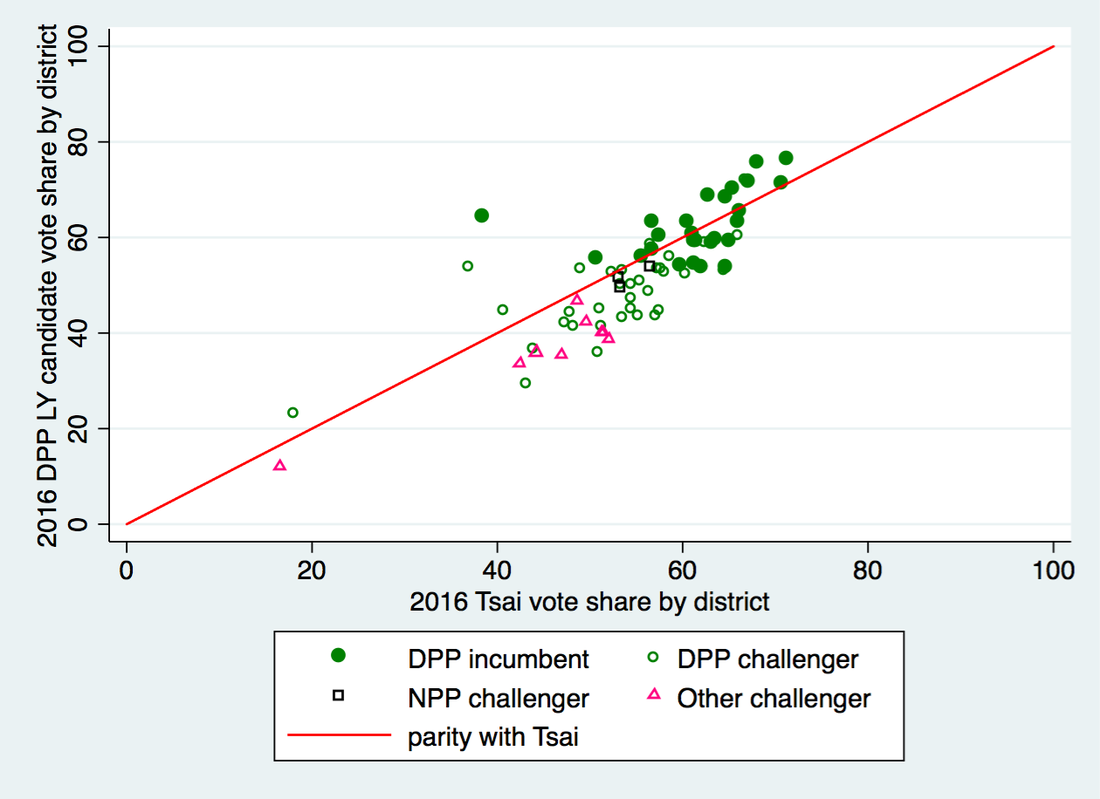
NPP candidates ran close to Tsai Ing-wen in the district races. Other non-DPP candidates, not so much.

​One of the more interesting developments in Taiwan's 2016 general election was the rise of so-called  "Third Force" parties--completely new entrants into the political system, rather than break-aways from the KMT or the DPP.  While some of the media commentary got a bit carried away about the significance of these new parties, the founding of one, the New Power Party (NPP), did pose a serious threat to the DPP's chances of winning a majority in the legislature. As an offshoot of the Sunflower Movement, the NPP positioned its message in a way calculated to appeal to pan-green voters, and it recruited high-profile candidates to run in district races, not just the party list. These district candidates had the potential to split the pan-green vote in what everyone expected would be a very anti-KMT year, and in a worst-case scenario for their side, help the KMT hold on to their legislative majority. 

In the end, a pan-green split didn't happen. A key reason is that the DPP headed off the threat early: the party formed a kind of pre-electoral coalition by yielding 11 districts to the NPP and other non-DPP candidates in exchange for their support not to run against DPP candidates elsewhere. And the districts that the DPP yielded were, with one exception, far past the critical 57th seat needed to deliver a legislative majority. It turned out to be a good deal for the DPP, which won 68 seats overall. It also, more surprisingly, turned out well for the NPP, which won all three district seats and five overall and became the third largest party in the LY. 
The NPP Surprise
My own expectation going into the election was that the NPP candidates would perform worse, on average, than a generic DPP challenger. (In fact, if you read that linked post closely, I was even more specific: 2-4 points worse, on average.) The rationale was pretty simple: Freddy Lim, Hung Tzu-yung, and Huang Kuo-chang were already household names, but their close association with the Sunflower Movement, and the acerbic rhetoric of Huang, especially, suggested they would be fairly polarizing as candidates. And in the traditionally blue-leaning districts of Taipei 5 (Lim) and New Taipei 12 (Huang), I thought they would turn off more voters than they attracted with that approach. 

So what actually happened? In the graph above, I've plotted the vote share of each DPP and DPP-endorsed district candidate against Tsai Ing-wen's share of the presidential vote in the same district. DPP incumbents are represented by solid dots; challengers (i.e. non-incumbents) by hollow ones; NPP candidates by hollow squares, and other non-DPP candidates by hollow triangles. (A hearty thank you to Frozen Garlic for doing the yeoman's work of sorting the presidential race vote totals by LY district and making these data publicly available.)

Thoughts on this below the break. 
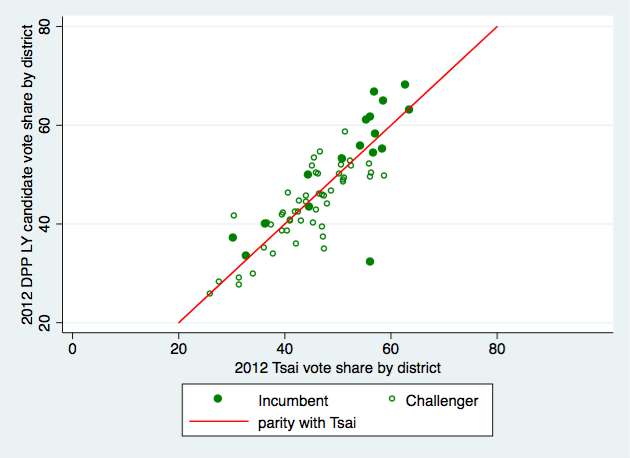
Read More
0 Comments

Five Things to Watch for on Election Night in Taiwan

1/11/2016

1 Comment

 
Picture
If 2016 looks like this, the KMT's LY majority is in big trouble.
​Tsai Ing-wen and the DPP are headed for a historic victory in Saturday’s elections, and the battle has already begun to define the narrative about what that means. One fairly common refrain is that this likely outcome will presage a fundamental realignment of the party system around issues beyond the blue-green divide over cross-Strait relations.
 
I’m skeptical that we are about to see this kind of realigning election, despite the attention given to the campaigns of the so-called “Third Force” parties. I’m also skeptical that this result will be the death knell for the KMT as a political party capable of winning elections. The KMT's coming defeat clearly reflects deep unhappiness with Ma Ying-jeou and the KMT’s rule over the last eight years, intensified by a spectacularly ill-timed economic downturn over the last few months (at least if you are a KMT member!) But an unpopular leader, toxic party brand, and disillusioned supporters are not fatal to major party survival, as the DPP showed after its 2008 electoral thrashing. So while a KMT recovery is not assured, and will at a minimum require some major leadership shakeups, we shouldn't expect the party simply to fade away, and for all those pan-blue supporters (still at least 30 percent of the electorate) to suddenly become fans of the DPP or one of the new parties.

Of course, I could be totally wrong--I'm just some guy on the internet, after all. But either way, we'll know a lot more soon: elections have a nice way of splashing everybody with a cold dose of reality. The results of the election this Saturday will give us the most concrete evidence we'll have to evaluate these competing narratives. So, in the interest of intellectual honesty, let me lay out my own expectations about what will happen, and what it means. Beyond who wins and loses, here's what I'll be watching most closely to see where Taiwanese politics is headed.

Read More
1 Comment

Why the KMT Is Going to Lose: It's the Economy

12/30/2015

0 Comments

 
Picture
Bad time to be an incumbent.
Some of the sharper commentary on the upcoming election has noted how livelihood issues, such as a growing wealth gap, soaring housing prices, and stubbornly high youth unemployment rate, are a big part of the reason public opinion has swung so dramatically against the KMT over the last two years, rather than cross-Strait relations. If I can hammer one thing home to outside observers about this election, it's that domestic issues, rather than cross-Strait relations, are what will decide this coming election. The outcome is not really a referendum on Taiwan's relationship with China, or an indication of a sudden surge in Taiwanese nationalism, but instead reflects deep concerns with "bread and butter" issues.  

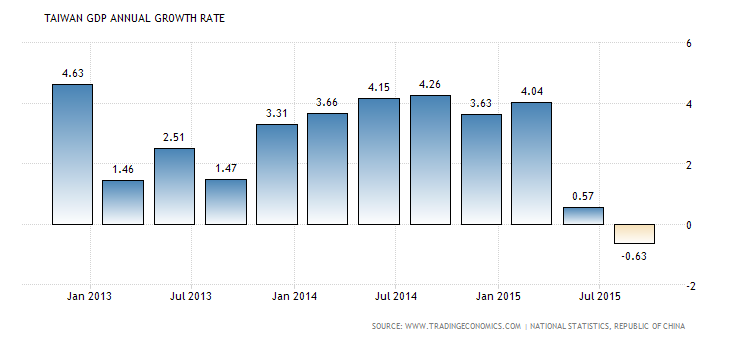
So what do I mean by bread and butter issues? Well, the commentary linked above is focused mostly on the concerns about income and wealth distribution that have been salient for a while and have gotten a lot of press in recent years. But in addition, there's something much more recent and fundamental working against the KMT right now: the economy is just not doing very well. Here's a sample of the (English-language) economic news reports coming out of Taiwan over the last few months: 

Taiwan is in a recession, and it's China's fault -- Forbes (December 1)
Weaker growth exposes downsides of China ties -- The Economist (November 14)
Industrial production falls 15% -- Taipei Times (November 20)
Unpaid leave hits 3-year high -- Taipei Times (November 17)
Taiwan nears recession, exports to China slump -- (October 31)
Taiwan exports in decline -- Voice of America (October 16)
GDP growth forecast cut to below 1% -- FocusTaiwan (October 15)
Tax revenue falls by 14.3% over previous year -- Taipei Times (October 13)
Rising pessimism about economy  -- China Post (October 12)
TISR poll: 81% believe economy in bad shape -- via Solidarity.tw (September 14)
TAIEX suffers worst-ever one-day drop -- Taipei Times (August 25)

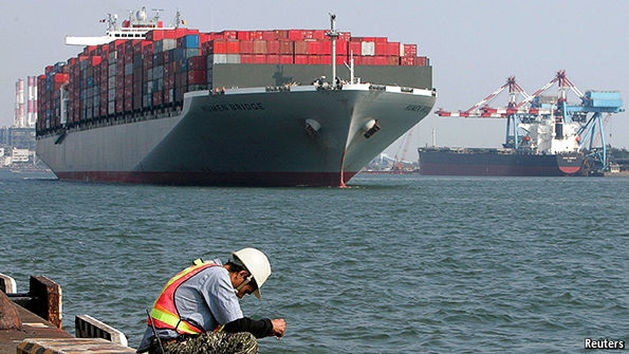
What all that reporting is trying to say can be summed up succinctly by the chart at the top of this page: Taiwan's economy is now rather suddenly headed into a recession, if it's not already in one. And that makes this a terrible moment to be running as an incumbent party. 
PictureSay it, Bill
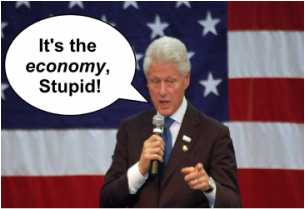
Economic Voting in Democracies. The theory of economic voting behind this claim is that economic conditions powerfully shape electoral outcomes in democracies everywhere. As Michael Lewis-Beck puts it in a great review article, "good times keep parties in office, bad times cast them out."

I should note that the evidence for this effect and its size varies a lot across countries, and the sometimes puzzling variation in the size of economic effects remains an open area of inquiry in political science. 

For instance, when the government is supported by a coalition of several parties, it's harder for voters to figure out which members deserve the blame for bad performance. The lack of a credible alternative to the incumbent--an opposition party or candidate who appears likely to do better--also leads to a weaker effect. (The opposition to the LDP in Japan has long struggled with a credibility problem, for instance.) And sometimes it's clear to voters that governments don't have much influence at all over bad economic outcomes because of global factors beyond their control, so they are less likely to punish incumbents at the ballot box.

In addition, voters turn out to have really short memories (i.e. they're "myopic," in the jargon of the discipline): the performance of the economy over the last six months matters a great deal more than the performance over a government's whole term in office. This is probably why the Conservatives in Britain, for instance, recently won re-election after presiding over an austerity-induced downturn during much of their first term.

Nevertheless, the basic claim, that economic downturns motivate voters to vote out incumbent governments when they can, is quite robust. In the United States, in fact, the state of the economy in the few months before a presidential election appears to be the single most important factor in who wins, more than the candidates themselves, their parties' policy platforms, or their campaigns.  

Picture
(Image Credit: The Economist)
Economic Voting in Taiwan? So what about in Taiwan? Given the current political environment, we should expect the state of the economy to have a major impact on the upcoming election. Taiwan right now has:
  • A long tradition of "stewardship" of the economy by the central government, dating back to the early martial law era, so the incumbent party at the national level is assumed to have significant responsibility for economic performance;
  • The presidency and legislature have been controlled by the same party for the last 7 years, so they can't escape blame;
  • The economic slowdown appears linked to a slowdown in the PRC's economy--linkage which was deliberately and explicitly promoted by the incumbent government;
  • The incumbent government has consistently made economic issues central to its policy platform;
  • The incumbent government has made prominent, highly specific economic pledges--for instance, President Ma's 6-3-3 promise.
  • The existence of a credible alternative to the incumbent--the DPP has previously held national office and is not a complete unknown or too looney to be taken seriously (and the bar for that is pretty low these days.)   
In short, this is close to a worst-case scenario for an incumbent party: standing for re-election during an unexpected economic downturn that appears to be linked directly to your own policies. Voters will kill you for that just about anywhere. Which brings me to the trends in election polls...
Picture
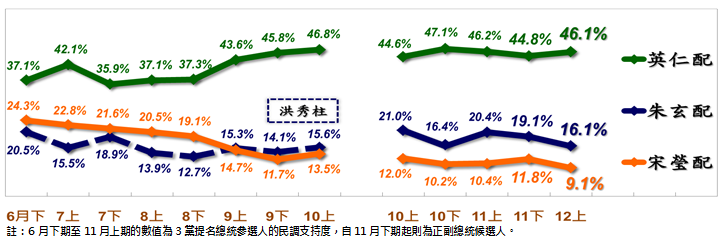
That's a large gap. (Source: TISR, 2015.12.14)
Bad Economy = Bad Polls. At about the same point that the economy started to sour over the last six months, Taiwan's presidential election turned from a competitive race into a rout. As the Taiwan Indicators Survey Research survey reproduced above shows, at the beginning of June, one could at least imagine a combined pan-blue effort that would give Tsai Ing-wen a real race: support for Hung Hsiu-chu and James Soong together was at 44.8%, above Tsai's 37.1%. But then what happened? Support for both cratered.

Part of that was Hung's own shortcomings as a candidate, but once she was replaced by Eric Chu, the KMT should have seen a real bounce. It hasn't. Chu is now down around 20% in the polls. That's likely to go up somewhat as pan-blue voters come back to the fold, and there are other polls showing him getting up to 30%. But even if pan-blue voters coordinated on a single candidate, the combined Chu-Soong support is nowhere near enough to make this a race anymore. It's all but over now. 

Some of this decline in the polls is undoubtedly self-inflicted--the fiasco with Hung and the presence of James Soong in a spoiler's role yet again could probably have been avoided. But even if Eric Chu had accepted the nomination back in March, and Soong hadn't joined the race, I still don't think this would be much of a contest right now. The reason is those economic figures: Chu is the standard-bearer for a party that in voters' eyes is squarely to blame for this economic downturn, and they're going to have a chance in less than three weeks to weigh in.

​Tsai Ing-wen is not Ma Ying-jeou or the KMT, and in these circumstances that looks like all she needs to win a comfortable victory. Cross-Strait policy, debate performances, campaign promises, VP selections--none of it is going to matter. In this election, it really is about the economy.
0 Comments

This is What a Nationalized Party System Looks Like

12/28/2015

0 Comments

 
Picture
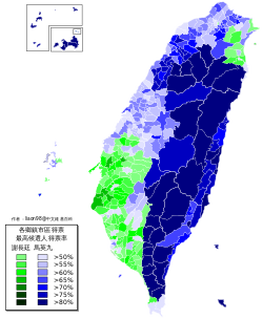
Taiwan's 2008 presidential election voting patterns by township.
Picture
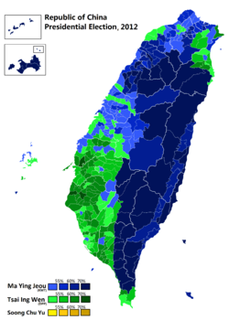
2012: greener everywhere, although this map doesn't show it very well.
In my previous post, I argued that the DPP's vote share in the legislative district races was likely to track Tsai Ing-wen's vote share fairly closely. From that basic intuition, I came up with a rank list of seats indicating how many districts the DPP would win with a given vote share for Tsai. That forecast rested on several assumptions:
  1. There wouldn't be a very large incumbent advantage for KMT legislators;
  2. Tsai's increase in vote share over 2012 would be uniform across districts;
  3. The electorate voting for president would look essentially the same as that voting for the legislature.

I spent much of the last post defending assumption 1. Here I want to relax assumption 2, that Tsai's vote share is going to increase uniformly across all districts. That's certainly not going to be true in a technical sense, but to what degree will it be violated? The conventional wisdom about Taiwan's electoral geography is that the the north is more solidly blue than other parts of Taiwan, so the KMT's vote share will decline less in Taipei than in, say, Tainan or Pingtung. But how much less is hard to predict.

Let me put the punch line up front: I don't think Tsai's increase in vote share is going to vary much by locality. Evidence follows after the jump.

Read More
0 Comments

Some Quick Thoughts on the Race for 2016

9/19/2015

0 Comments

 
Picture
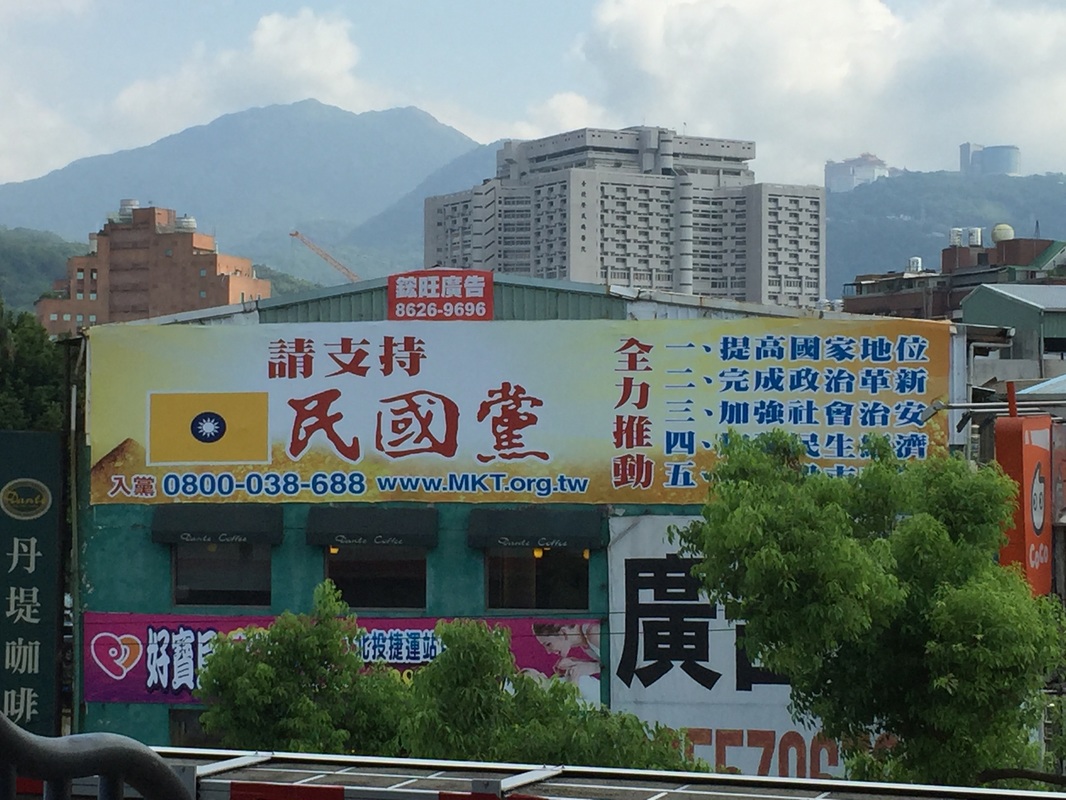
One of the more creative ways to run away from the KMT's toxic brand right now: a billboard for the new Republic Party (Min-Kuo Tang, a play on the Kuo-min Tang).
We're now four months away from the presidential and legislative elections in Taiwan, to be held on January 16th. At this point polls start to tell us something meaningful about how the election will turn out. To my eye, there are three things that stick out:

1. Taiwanese voters care most about the economy, and they overwhelmingly evaluate it as "bad."
A Taiwan Brain Trust poll that came out yesterday reports that about 64% of respondents named economic development as the primary issue in next year's elections--far outstripping government effectiveness (about 17%) and cross-Strait relations (only about 4.5%). 

Another poll from Taiwan Indicators Survey Research ll (TISR) that came out on Monday finds that an astounding 84% of respondents evaluated the overall state of the domestic economy as "bad" ("認為國內整體經濟狀況不好“); only 8% thought it was good. 

The headline numbers in both these polls focus on support for the three major candidates--Tsai Ing-wen, Hung Hsiu-chu, and Soong Chu-yu (aka James Soong). I think they're burying the lede. Economic conditions are a powerful determinant of election outcomes: in general, incumbents get the credit when people think the economic is doing well, and they get the blame when it is not--whether or not they actually have much control over economic outcomes at all. So the fact that most Taiwanese poll respondents are emphasizing the state of the economy, and that the large majority think it is bad, bodes very poorly for the KMT. (Note that this cannot just be Pan-Green supporters expressing discontent about the economy: this is 84% of all respondents. Dissatisfaction with the economy crosses party lines.) 

These results suggest that, like in the local elections in 2014, the KMT is going to be fighting a massive headwind. Even if they had a strong candidate (ahem, Chu Li-lun?) atop the ticket, I would expect them to lose with these numbers. With Hung Hsiu-chu as the nominee, and James Soong running yet another third-party campaign that's offering an alternative to Pan-Blue voters who don't like Hung, the presidential election already looks overdetermined. The KMT is going to lose, badly. And Tsai Ing-wen, by default, is going to win. 

At this point, though, I'd be very cautious about interpreting an impending DPP victory as anything other than a rejection of the KMT. There will inevitably be people in Taiwan and in Washington, DC who will frame this outcome as a repudiation of closer cross-Strait relations with the PRC, or an endorsement of Taiwanese independence. It's time to start beating the drum that the election is not about cross-Strait relations. It's not about independence or unification. It's not really even about a new "third force" of youth activism and social progressive politics. The 2016 election is about the economy. 
  
Picture
2. The KMT is really unpopular, but support for the DPP and Tsai Ing-wen is soft.
Dissatisfaction with the KMT is really high right now. Taiwan Brain Trust puts it at 71%, which is a significant improvement from December 2014, when the rate was 80%.

What is more surprising is that the DPP is still not very popular in absolute terms. Throughout 2015, the DPP has had higher negatives than positives in the Taiwan Brain Trust survey results. The most recent poll finds about 45% dissatisfied with the DPP, and 42% satisfied. That's actually a significant improvement as well; for polls in March, April, and June over half of respondents were dissatisfied with the DPP. The TISR results are more positive for both the DPP and KMT, probably because survey uses a "feelings thermometer" to rank the parties on a scale from 0 to 100: the DPP ranks slightly positively with a net score of 52.0, as compared to the KMT's 35.7. That's still not particularly strong given the circumstances. 

Tsai Ing-wen's polling support is also still short of 50%; TISR finds 43.6% of respondents intend to vote for her, which is a new high in recent months. Undecideds and those saying they won't vote combined are still 25% of the electorate. Taiwan Brain Trust puts it a bit higher, at 46.8%.

What this suggests to me, again, is that Tsai and the DPP are positioned to do well in 2016 mostly because they're not Ma Ying-jeou and the KMT. Given how widespread dissatisfaction with the economy is right now, they're going to win a lot of swing votes as the "lesser of two evils." 

Picture
3. The NPP might replace the TSU in the legislature.
The Taiwan Solidarity Union has three seats in the current LY. They're the deep green alternative to the DPP, and they've been struggling to hang on ever since the electoral system change in 2008 shut them out of the legislature. They need to pass 5% in the party list vote to get seats, which they did easily in 2012, winning 8.96%. They're currently polling at less than half that: they're at about 4.1% in the Taiwan Brain Trust poll. They're being outpolled now by the New Power Party (時代力量), at 6.8%, and James Soong's People First Party at 5.6%. 

There's a real possibility that the NPP takes a lot of votes from the TSU, passing the PR threshold while the TSU doesn't, and effectively replacing it on the deep green end of the political spectrum. It's notoriously difficult to poll support for small parties, so treat these as very rough estimates. The NPP is deliberately trying to appeal to young voters, who turn out at lower rates and are less predictable in their voting patterns than older generations. For another, the NPP is actually cooperating with the DPP in its district nominations--I'm not sure how this might affect the party list vote. 

(A third reason to be wary of the Taiwan Brain Trust numbers on the small parties: Hsu Yung-ming (徐永明), a professor at Soochow University, is both the polling director for the survey and now a legislative candidate for the NPP.)

There's a real danger here for the Pan-Green camp if their voters fail to coordinate in the party list vote: the Green Party and Social Democratic Party are running a joint list that may appeal to a lot of the same young, well-educated voters that the NPP is making a play for. They're currently polling at 1.8%, according to the Taiwan Brain Trust survey. It's not hard to imagine the NPP, Green-SDP, and TSU all pulling some Pan-Green support and each getting 3-4% of the PR list vote, leaving them all with no seats, while the PFP passes the threshold and wins several seats. If the district results end up closely split, the Pan-Green camp could even be denied a majority in the LY despite a significant advantage in the overall share of the vote. 

While I don't think it's particularly likely to happen, a Pan-Green win in the popular vote that leaves a Pan-Blue majority in control of the legislature would be a serious problem for Taiwan's democracy. So one thing I'll be paying close attention to in this election is how, or whether, this coordination problem is resolved in some way before the election.

0 Comments

    RSS Feed

    About Me

    I am a political scientist with research interests in democratization, elections and election management, parties and party system development, one-party dominance, and the links between domestic politics and external security issues. My regional expertise is in East Asia, with special focus on Taiwan.

    Posting on Bluesky @kharist.bsky.social

    Archives

    November 2025
    October 2025
    September 2025
    August 2025
    July 2025
    June 2025
    April 2025
    February 2025
    January 2025
    November 2024
    October 2024
    May 2024
    March 2024
    January 2024
    December 2023
    November 2023
    October 2023
    August 2023
    May 2023
    April 2023
    March 2023
    February 2023
    January 2023
    December 2022
    November 2022
    October 2022
    September 2022
    August 2022
    June 2022
    May 2022
    April 2022
    March 2022
    February 2022
    January 2022
    December 2021
    March 2021
    February 2021
    December 2020
    October 2020
    September 2020
    August 2020
    July 2020
    June 2020
    September 2019
    August 2019
    November 2018
    August 2018
    June 2018
    February 2018
    January 2018
    October 2017
    August 2017
    December 2016
    November 2016
    September 2016
    August 2016
    July 2016
    March 2016
    February 2016
    January 2016
    December 2015
    November 2015
    October 2015
    September 2015
    July 2015
    June 2015
    May 2015
    March 2015
    February 2015
    January 2015
    November 2014
    October 2014
    September 2014
    August 2014
    July 2014
    May 2014
    April 2014
    March 2014
    February 2014
    January 2014
    December 2013
    November 2013
    October 2013
    September 2013

    Categories

    All
    1992 Elections
    2008 Elections
    2012 Elections
    2014 Elections
    2016 Elections
    2020 Elections
    2022 Elections
    2024 Elections
    2026 Elections
    Aacs
    Aborigines
    Alex Tsai
    Alicia Wang
    Annette Lu
    Announcements
    Apsa
    Apsa Cgots
    Arthur P Wolf
    Artificial Intelligence
    Blog Meta
    Book Review
    Brookings Institution
    Campaign Regulation
    CCP
    CDDRL
    CEC
    Chang Ching Chung
    Chang Chun Hsiung
    Chang Jung-wei
    Chang Li-shan
    Chang Ming-ta
    Chang Sho-wen
    Chen Che-nan
    Chen Chien-nian
    Chen Chi Mai
    Chen Chin-te
    Chen Ding-nan
    Chen Fu-hai
    Cheng Chao-fang
    Cheng Cheng-ling
    Cheng Pao-ching
    Chen Kuang-fu
    Chen Kuan-ting
    Chen Ming-wen
    Chen Ou-pu
    Chen Shih Chung
    Chen Shih-chung
    Chen Shui Bian
    Chen Tsang-chiang
    Chen Wan-hui
    Chen Wei-chung
    Chen Ying
    Chen Yu-chen
    Chiang Chi Chen
    Chiang Chi-chen
    Chiang Ching Kuo
    Chiang Jui-hsiung
    Chiang-kai-shek
    Chiang Tsung-yuan
    Chiang Wan An
    Chiang Wan-an
    Chin Hui Chu
    Chou Chiang-chieh
    Chou Chun-mi
    Chou Hui-huang
    Chuang Suo Hang
    Chung Chia-pin
    Chung Tung-chin
    Citizen 1985
    Civil Society
    Conferences
    Control Yuan
    Council Of Grand Justices
    Cross-party-negotiating-committee
    Cross Strait Relations
    CSSTA
    Defense Spending
    Demography
    Developmental State
    Diplomacy
    Disinformation
    DPP
    DPP Policy Papers
    Eats
    Economic Security
    Economic Voting
    Electoral Geography
    Electoral Reform
    Electoral Systems Wonkery
    Energy Policy
    Eric Chu
    Executive Yuan
    Fan Yun
    Fellowship
    Frank Hsieh
    Freddy Lim
    Frida Tsai
    Fu Kun Chi
    Fu Kun-chi
    Germany
    Han Kuo Yu
    Han Kuo-yu
    Hau Lung Bin
    Hau Pei Tsun
    Henry Rowen
    Ho Kan-ming
    Hoover Institution
    Housing
    Hou You Yi
    Hou You-yi
    Hsiao Bi Khim
    Hsiao Bi-khim
    Hsieh Fu-hung
    Hsieh Kuo Liang
    Hsieh Kuo-liang
    Hsieh Lung-chieh
    Hsieh Sam Chung
    Hsu Chen-wei
    Hsu Chih-jung
    Hsu Chung-hsin
    Hsu Hsin-ying
    Hsu Shu-hua
    Hsu Ting-chen
    Huang Hong-cheng
    Huang Kuo Chang
    Huang Kuo-chang
    Huang Min-hui
    Huang Shan Shan
    Huang Shan-shan
    Huang Shih Ming
    Huang Shiou-fang
    Huang Wei-che
    Huang Yung-chin
    Human Rights
    Hung Hsiu Chu
    Hung Tzu Yung
    Hung Tzu-yung
    Influence Operations
    In Memoriam
    Internship
    James Soong
    Japan
    Jiang Yi Huah
    Job Market
    John Chiang
    John Wu
    Journal Of Democracy
    Judicial Yuan
    Kao Hung An
    Kao Hung-an
    Kawlo Iyun Pacidal
    Ker Chien Ming
    KMT
    Kmt History
    Ko Chih-en
    Kolas Yotaka
    Ko Wen Je
    Lai Ching Te
    Lai Ching-te
    Lai Feng-wei
    Lai Hsiang-ling
    Lee Chin-yung
    Lee Chun Yi
    Lee Chun-yi
    Lee Teng-hui
    Legal-wonkery
    Legislative Yuan
    Liang-kuo-shu
    Liang Su Jung
    Lien Chan
    Lii Wen
    Lin Chia-lung
    Lin Chih-chien
    Lin Fei-fan
    Lin Geng-ren
    Lin Hung Chih
    Lin Ming-chen
    Lin Tsung-hsien
    Lin Yang Kang
    Lin Zi Miao
    Lin Zi-miao
    Liu Chao-hao
    Liu Cheng-ying
    Liu Chien-kuo
    Liu Kuo Tsai
    Lo Chih Cheng
    Lu Hsiu Yi
    Lu Shiow-yen
    Martial Law
    Ma Vs Wang
    Ma Ying Jeou
    Media
    Media Freedom
    Min Kuo Tang
    Nationalism
    Natsa
    NCC
    New Power Party
    Nuclear Power
    Occupy LY
    Pingpuzu
    Political Economy
    Political Science
    PRC
    PTIP
    Publications
    Public Opinion
    Quality Of Democracy
    Ramon Myers
    Rao Ching-ling
    Recall Elections
    ROC Constitution
    Russia
    Saidai Tarovecahe
    Sean Lien
    Security Studies
    Semiconductor Industry
    Shen Hui-hung
    Shen Lyu Shun
    Simon Chang
    Song Kuo-ting
    South Korea
    Speaker Series
    Stanford
    Statistics
    Street Protests
    Su Ching-chuan
    Su Huan-chih
    Su Jia Chyuan
    Su Jia-chyuan
    Sunflower Movement
    Su Tseng-chang
    Taiwanese Economy
    Taiwan Journal Of Democracy
    Taiwan People's Party
    Taiwan Rural Front
    Taiwan Solidary Union
    Taiwan Studies
    Taiwan World Congress
    Terry Gou
    Testimony
    The Diplomat
    This Week In Taiwan
    Ting Shou Chung
    Tpp
    Trade Relations
    Trans Pacific Partnership
    Tsai Chi-chang
    Tsai Ing Wen
    Tsai Shih-ying
    Tsao Chi-hung
    Tsao Er-yuan
    Tseng Yung Chuan
    Tzu Chi
    Ukraine
    United Nations
    Uscc
    US Taiwan NextGen
    Us Taiwan Relations
    V-dem
    Wang Chien-hsien
    Wang Chung-ming
    Wang Huei-mei
    Wang Jin Pyng
    Wang Mei-hui
    Wan Mei-ling
    Wei Yao Kan
    Wellington Koo
    Weng Chang-liang
    Wild Lily Movement
    Wilson Center
    Wu Den Yi
    Wu Yung Hsiung
    Xi Jinping
    Yang Cheng-wu
    Yang Shi-chiu
    Yang Wen-ke
    Yang Yao
    Yao Eng-chi
    Yao Wen-chih
    Yosi Takun
    You Si-kun
    Yu Shyi Kun

    RSS Feed

Powered by Create your own unique website with customizable templates.